
OUTDOOR BACKPACK MATERIALS / OEM BUYER GUIDE
Best Materials for Outdoor Backpacks
For B2B buyers, the best materials for outdoor backpacks are the ones that match the activity, expected load, rain exposure, sales channel, and bulk-order economics—not a single fabric name on a hangtag. Brands, importers, wholesalers, distributors, and private-label sellers usually need a fabric system that can be specified, sampled, and repeated across production lots.
In practice, that means choosing among coated polyester, high-tenacity nylon (including Cordura®-class constructions), ripstop, ballistic-style weaves, UHMWPE/Dyneema® composites, X-Pac® laminates, recycled rPET, and canvas—then pairing the shell with the right coating, seams, and hardware. This guide compares those options for outdoor backpack OEM/ODM programs and separates fabric-panel performance from finished-bag performance. A coated nylon panel can resist water under a hydrostatic test; stitched seams, coil zippers, and webbing holes can still let water into the pack.
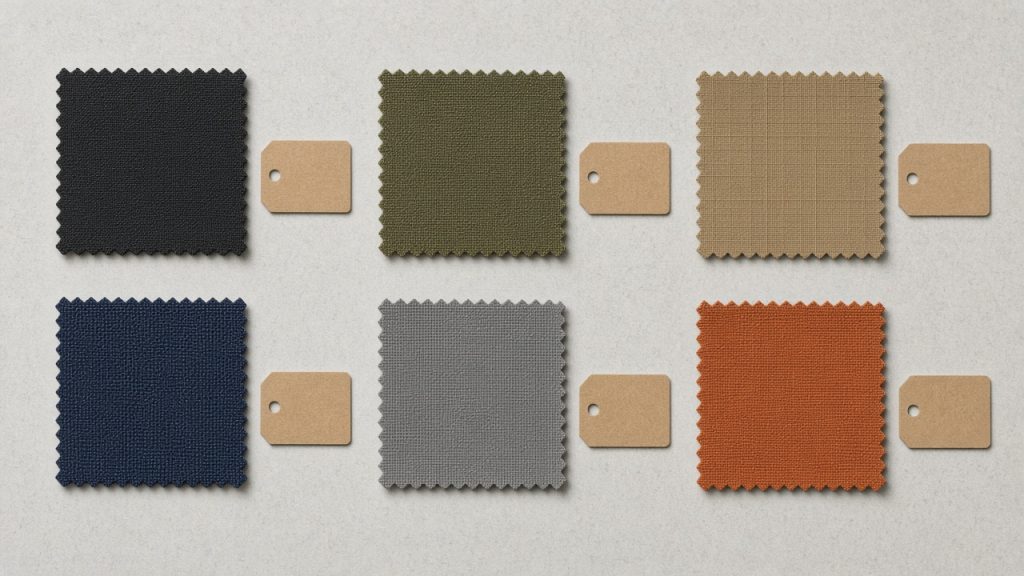
Fabric performance vs finished-bag performance
Keep these layers separate in the brief and on the sample report:
| Layer | What it describes | Typical evidence |
|---|---|---|
| Face fabric + yarn | Denier, fibre (nylon/polyester/UHMWPE), weave (plain, ripstop, ballistic) | Mill TDS, fibre brand callout |
| Finish / coating / laminate | DWR, PU, PVC, TPU film, multi-layer laminate | Coating weight, film type, fabric hydrostatic result |
| Bag construction | Seams, zipper type, taped or welded joints, pocket openings | Loaded rain check, agreed finished-bag method |
| Assembled durability | Strap anchors, base abrasion, handle pull | Sample use with intended contents; optional lab tests on the bag |
ISO 811 and AATCC TM127 measure fabric resistance to water under hydrostatic pressure. They do not, by themselves, prove a backpack is waterproof. Spray / surface beading tests (for example AATCC TM22) assess DWR behaviour and are not interchangeable with hydrostatic results.
Abrasion methods also differ. ISO 12947 (Martindale) and ASTM D3884 (Taber rotary platform) use different mechanics. Cycle counts from one method should not be treated as equal to the other, and laboratory abrasion is only one input into field durability.
How to Choose the Best Materials for Outdoor Backpacks
Use this table as a first filter when choosing the best materials for outdoor backpacks for a given program. Confirm the exact mill style, coating, and colour process on the quotation.
| Intended use / channel | Starting shell direction | Prefer when… | Usually avoid when… | Watch during sampling |
|---|---|---|---|---|
| Entry outdoor / promo daypack, broad wholesale SKUs | 600D polyester + PU; stock colours | Price, printability, and colour availability matter more than ultra-light weight | Trail abrasion is severe or “waterproof” is a finished-product claim | Print clarity, coating smell/hand, base panel wear |
| Everyday hiking / travel pack (mid tier) | 900D polyester or 500D high-tenacity nylon; reinforced base | Need denser hand and better abrasion without laminate cost | Weight target is aggressive | Loaded strap pull, zipper run, base scrape |
| Heavy abrasion (airport floors, gear haul, equipment packs) | 1000D nylon (e.g. Cordura® Classic class) or 1680D ballistic-style polyester on base/high-wear zones | Structure and abrasion dominate retail value | Ultralight hiking positioning | Stiffness, sewing thick layers, freight weight |
| Ultralight technical hiking | Ripstop nylon or UHMWPE / Dyneema® composites; sometimes X-Pac® laminates | Strength-to-weight and low water pickup are the product story | Budget lines or many Pantone colourways | Needle holes, seam design, hardware compatibility |
| Wet-weather positioning (rain, splash) | Coated fabric + reviewed closures; TPU or laminate if welding is planned | Exposure is defined and test method is agreed | Marketing says “waterproof” but seams stay open-stitched | Fabric hydrostatic vs bag water entry paths |
| ESG / recycled-content claims | GRS- or RCS-documented rPET (or recycled nylon) in a matched denier | Channel needs documented recycled content | Claim wording exceeds the certified scope | Which components are covered; colour lead time |
| Lifestyle / heritage outdoor | Canvas or coated canvas | Natural hand and visual story fit the brand | Frequent wet use without a finish plan | Water uptake, colour bleed, weight |
Cordura® Classic is defined by INVISTA as high-tenacity, air-jet textured nylon 6,6 fabrics commonly in 330D–1000D (with 500D and 1000D widely used in bags). Dyneema® is a brand of UHMWPE; official materials guidance describes composites used in packs for high strength-to-weight, low water absorption, and dimensional stability. X-Pac® laminates (Dimension-Polyant) combine face fabric, X-PLY® reinforcement, and film layers and are marketed as waterproof laminates—finished bags still need matching seam and closure design.
What denier does—and does not—tell you
Denier is yarn linear density (grams per 9,000 metres of yarn). Higher denier often means a thicker yarn and, in similar weaves, a heavier, more abrasion-resistant cloth. Common outdoor backpack ranges:
- Linings / ultralight panels: roughly 210D–420D
- Mainstream shells: 500D–600D
- Heavier outdoor / travel: 900D–1000D
- Structured “ballistic” looks: often 1680D polyester constructions
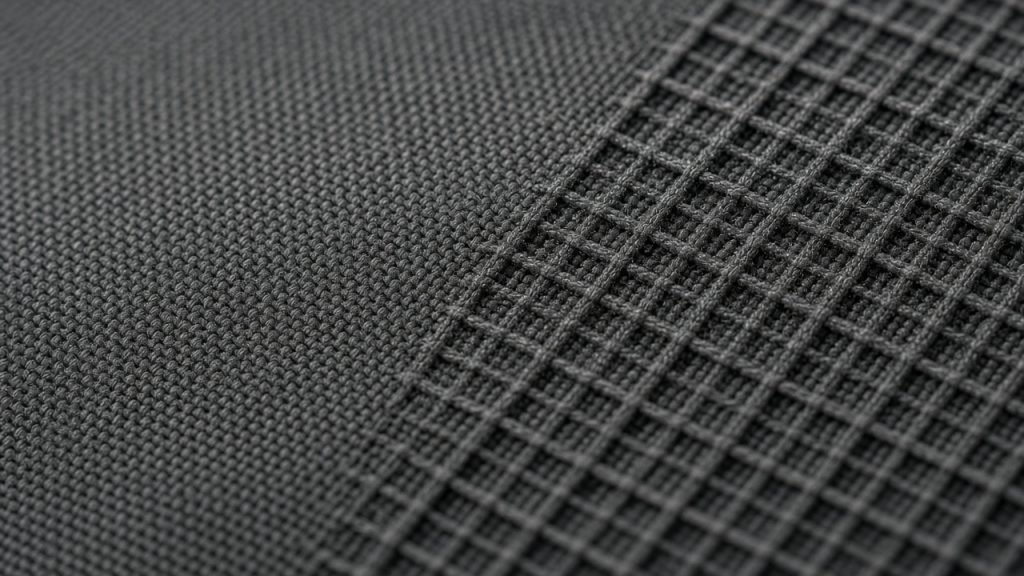
Denier does not equal waterproofing. Uncoated fabric can wet out regardless of denier. Tear behaviour also depends on ripstop grids, basketweaves, laminates, and coatings—not only the D number. Always pair denier with finished fabric mass (gsm), weave, and coating on the tech pack.
Best Materials for Outdoor Backpacks by Fabric Type
Polyester 600D / 900D / 1680D
Polyester remains a practical default among the best materials for outdoor backpacks because stock colours are broad, printing and heat transfer are straightforward, and cost is easier to control than branded high-tenacity nylon.
- \1 — common for school, promotional outdoor, gym, and mid-market daypacks.
- \1 — denser hand for business, laptop, and premium daypacks without jumping to ballistic weight.
- \1 — structured, abrasion-forward look for travel and premium laptop packs; heavier and usually costlier per metre.
Similar deniers from different mills can still differ in yarn, weave density, and coating. Approve a swatch and a sewn sample, not only a name on a quote.
Nylon, ripstop, and Cordura-class fabrics
High-tenacity nylon 6,6 (including Cordura® Classic constructions) is often selected among the best materials for outdoor backpacks where abrasion and tear resistance need to justify a higher fabric cost—hiking packs, tactical-adjacent lines, and reinforced bases. Ripstop nylon helps stop tears from running; it does not replace a coating for water resistance.
If the brand requires hangtags or trademark use, confirm the mill style and brand approval path early. “Cordura equivalent” without a defined TDS leaves colour, hand, and abrasion open to interpretation.
Dyneema® / UHMWPE composites and X-Pac® laminates
These belong in premium ultralight or technical programs. Expect higher fabric cost, fewer stock colours, longer fabric lead paths, and more care around sewing (needle type, seam placement, reinforcement). They are rarely the first choice for a multi-colour wholesale assortment where unit price and dye-lot flexibility dominate.
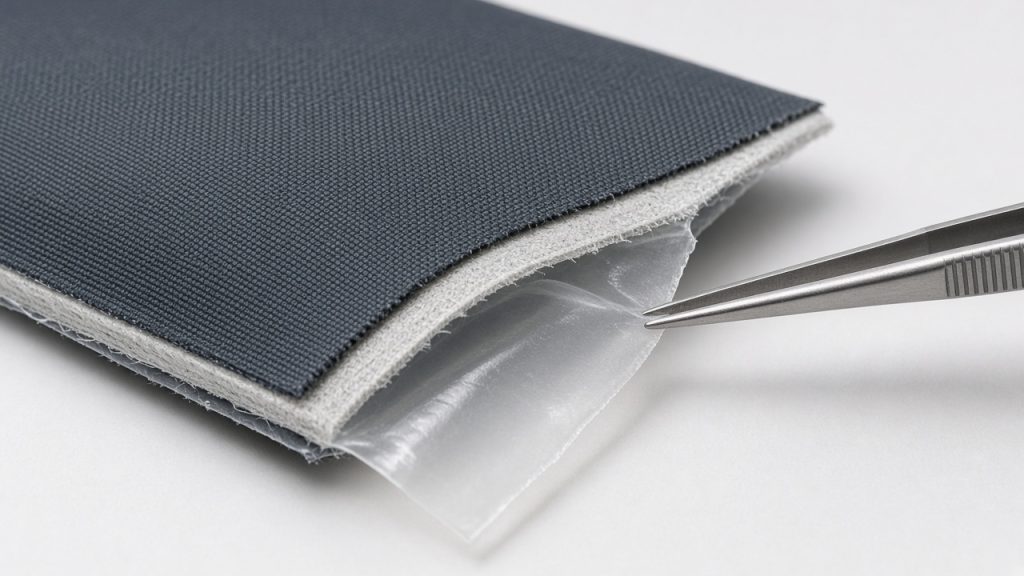
Coatings: DWR, PU, PVC, TPU
| Finish | Role | Limitation |
|---|---|---|
| DWR | Surface beading | Wears with abrasion and washing; not a bag waterproof proof |
| PU coating | Flexible water resistance on many daypacks | Open seams and zippers still leak |
| PVC coating | Stronger barrier, wipe-clean feel | Stiffer hand; some retail chemistry preferences avoid PVC |
| TPU film / laminate | Higher barrier; often used when welding is planned | Process and cost differ from simple PU-backed Oxford |
For EU-bound products, chemical compliance discussions often reference REACH obligations for substances in articles. PFAS-related restrictions and retailer policies are tightening in several markets; if the brief requires fluorine-free DWR, ask for declarations and test evidence tied to the destination market—not a generic “eco” label.
Recycled rPET and canvas
rPET can match virgin polyester of the same construction when the mill build is equivalent. For claims, Textile Exchange’s RCS and GRS provide recycled-content verification and chain-of-custody frameworks. GRS has a higher consumer-facing recycled-content threshold than RCS for logo use; keep claim wording inside the documented scope (which component, what percentage).
Canvas suits lifestyle outdoor stories. Without wax, coating, or a water-repellent plan, cotton-rich canvas absorbs water and gains weight. Recycled polyester “canvas” looks exist when brands want a canvas aesthetic with synthetic behaviour.
Hardware that belongs in the same material brief
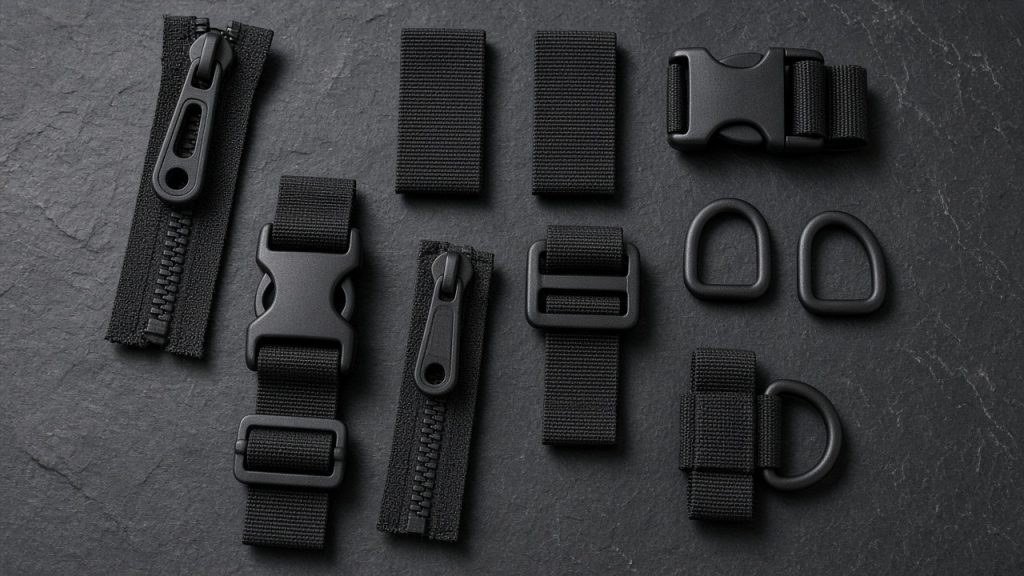
Zippers, webbing, and buckles fail in the field as often as shell fabric. Specify zipper size and construction (for example #5 coil, reverse-coil, or water-resistant tape), webbing width/fibre for load paths, and buckle size matched to webbing. Named zipper brands (commonly YKK) are a buyer preference in many outdoor lines; if an alternate is allowed, define what “equivalent” means for dimensions, cycling feel, and colour.
How material choices affect cost and order feasibility
Material, size, structure, logo, and accessories all change cost—and they can change how quantity should be allocated across colours and styles. Fabric dye lots, custom Pantone programs, specialty laminates, molded logos, and branded hardware each carry their own sourcing constraints. Finished-bag sewing quantity and material purchasing quantity are not always the same number.
For projects in the 500+ unit planning range, quantity splits matter as much as the headline total:
- 600 pcs × 1 style × 2 stock colours is a different sourcing brief from 600 pcs × 3 styles × 4 custom colours.
- Sharing one shell fabric and zipper colour across SKUs usually simplifies purchasing more than changing only the woven label.
- Custom-dyed nylon or limited laminate colours often need earlier colour lock than stock polyester Oxford.
If budget or calendar is tight, keep the carrying system, base reinforcement, and closure quality; adjust decorative panels, extra pockets, custom hardware, and packaging complexity first. Changing to a lighter denier “to save money” without checking abrasion can create returns that cost more than the fabric saving.
Amazon private-label sellers should treat packaging, carton marks, and dimensional consistency as part of the same brief when listing stability matters. Do not assume a material choice automatically satisfies any marketplace policy; verify listing and packaging rules against current Amazon seller documentation for your category.
Sample checklist for outdoor backpack materials
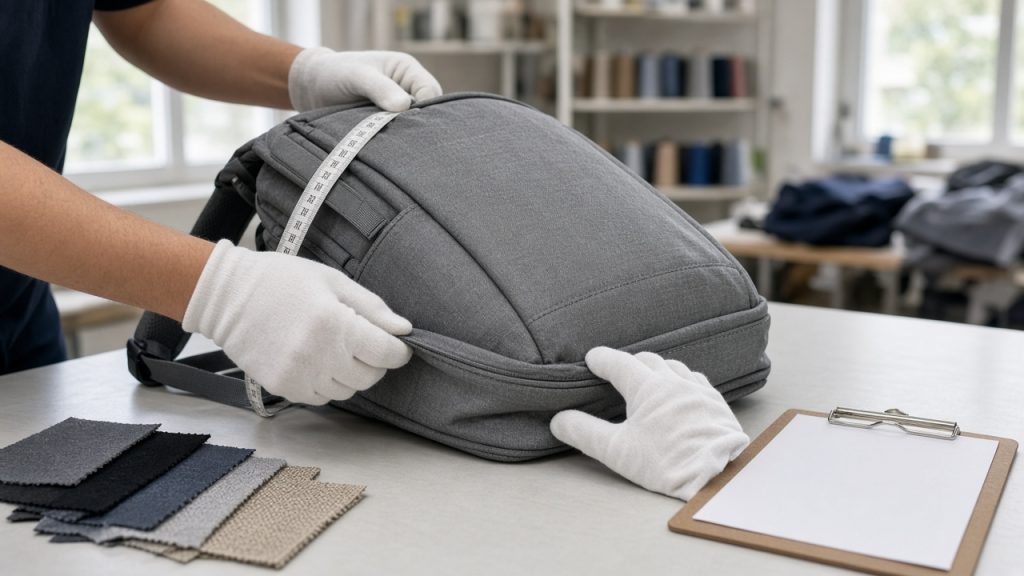
Approve the sample as the production reference. Appearance alone is not enough.
| Check | What to record |
|---|---|
| Fabric identity | Fibre, denier, gsm, weave, mill/style if known, coating/laminate |
| Colour | Stock vs custom; approved under agreed light; lot reference |
| Water story | Fabric result method (e.g. ISO 811 / AATCC TM127) vs finished-bag exposure agreed |
| Abrasion zones | Base, corners, and strap contact; optional Martindale or Taber method if required |
| Load points | Shoulder strap anchors, haul handle, daisy chains; bartack / box-X present |
| Closures | Zipper size/brand if specified; operation under load; buckle/webbing match |
| Fit & access | Intended contents packed; pocket reach; strap adjustment range |
| Logo & labels | Method, size, position, wash/abrasion behaviour on that fabric |
| Packing | Folded size, foam crush, how the bag presents after unpacking |
| Revisions | Written change list; which sample revision is the bulk standard |
Bulk risks that show up after a “pretty” sample: coating variation between dye lots, zipper tape colour drift, thinner foam substitutions, missing reinforcement at strap roots, and water entry at needle holes when marketing language overstated the construction.
RFQ information list (for a usable outdoor backpack quote)
Send enough detail that two factories are quoting the same product:
- Backpack type and primary activity (day hike, travel, cycling, climbing approach, etc.)
- Approximate dimensions / capacity and intended load
- Quantity \1 (not only a total)
- Preferred shell, lining, coating, and any brand-name fabrics that must or must not be used
- Logo methods and placement sketches
- Hardware preferences (zipper series, buckle type, webbing widths)
- Packaging (polybag, hangtag, insert, carton marks) for wholesale, retail, or ecommerce
- Destination market(s) and any chemical / claim constraints (REACH awareness, PFAS-free DWR, GRS wording)
- Reference photos, drawings, existing sample, or concept notes
- Planned purchasing window (for capacity and material planning—without treating any date as a factory promise until confirmed)
Development can start from photos, drawings, existing samples, or concepts. Final production specs should follow the approved sample.
FAQ
Is higher denier always better for outdoor backpacks?
No. Higher denier often improves abrasion resistance and structure but adds weight and cost. Many packs use a mid denier body with a heavier base panel.
Does waterproof fabric mean a waterproof backpack?
No. Fabric hydrostatic tests evaluate the textile. Finished-bag water entry depends on seams, zippers, and openings. Define exposure and verification before using “waterproof” on packaging.
When should we choose Cordura-class nylon instead of 600D polyester?
When abrasion, tear strength, and brand positioning justify higher fabric cost—especially on bases and high-wear panels. For broad colour assortments and print-led wholesale lines, coated polyester is often the more practical starting point.
When are Dyneema or X-Pac worth specifying?
When ultralight strength-to-weight or a laminate waterproof story is central to the SKU and the commercial plan accepts specialty fabric cost and colour limits. They are a poor default for multi-SKU colour programs aimed only at lowest landed cost.
What should private-label sellers verify on materials for online listings?
Keep listing claims aligned with what you can support: recycled content scope, water-resistance wording, weight, and dimensions. Package and carton consistency matter for ecommerce operations; material choice alone does not settle marketplace compliance.
How should a 500+ unit project allocate colours and materials?
Fewer style–colour combinations with shared shell and trim usually reduce sourcing friction. Custom colours and specialty laminates need earlier lock-in. Review allocation before treating any quantity split as production-ready.
Plan an outdoor backpack materials review with Voufan Bags
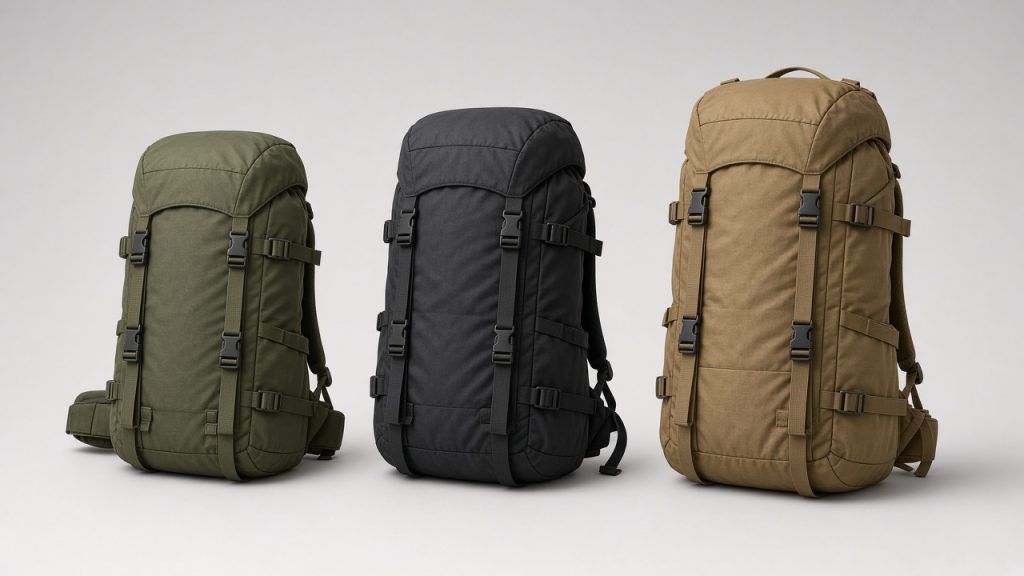
Voufan Bags helps brands shortlist the best materials for outdoor backpacks as a China OEM/ODM custom bag manufacturer based in Shenzhen (since 2008). We support brands, importers, wholesalers, distributors, and private-label sellers with custom bag development, sampling, material sourcing, manufacturing, quality control, and export support. Outdoor sports bags are one of the categories we manufacture alongside medical & healthcare bags, pet carrier bags, tool bags & equipment cases, cooler & delivery bags, and protective / specialty bags.
If you are preparing an outdoor backpack or outdoor sports bag program, send the RFQ items above—especially quantity by style and colour, destination market, and the water/abrasion story you need to support. We can review material options against your use case and move into sampling once the brief is clear.
Contact: sales@voufanbags.com · Contact page · Outdoor sports bags · OEM manufacturing