
How to Choose a Reliable Custom Backpack Manufacturer
Choosing a custom backpack manufacturer is not only about finding a factory that can sew a bag at an acceptable price.
For brands, importers, wholesalers and private-label sellers, the bigger question is whether the manufacturer can turn your design into a repeatable product — with the right materials, construction, branding, quality standard and production control.
A supplier may make a good-looking first sample but struggle to repeat it in bulk production. Another may quote quickly but leave important details such as zipper specifications, foam thickness, reinforcement points or packaging undefined. These gaps usually become expensive after an order is placed.
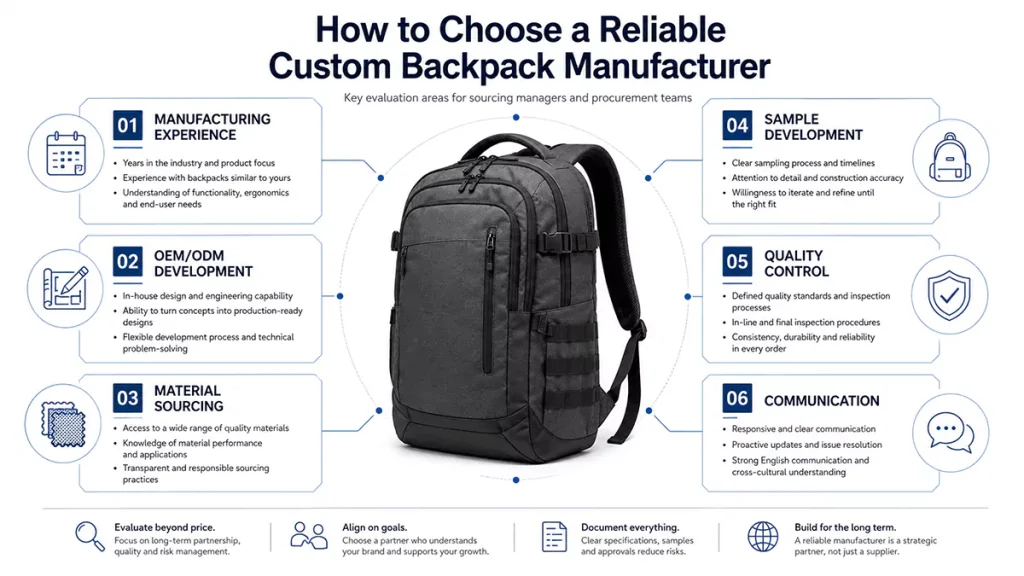
A reliable manufacturer should therefore be evaluated across the full development process: product understanding, material sourcing, sample development, manufacturing, quality control and communication.
This guide explains what to check before choosing a custom backpack manufacturer and what questions are worth asking before you move to sampling or bulk production.
1. Start With a Clear Backpack Requirement
Before comparing manufacturers, first make sure they are comparing the same product.
A backpack quotation based only on one reference photo is rarely enough for a fully customized project. Two bags can look almost identical from the outside but have very different manufacturing costs because of the fabric, lining, foam, internal reinforcement, zipper quality, hardware and construction.
At minimum, your manufacturer should understand the intended use of the backpack, approximate dimensions, required compartments, preferred materials, colors, branding method, estimated order quantity and target market.
For more technical products, additional information may be necessary.
A hydration backpack, for example, may require specific bottle pockets, breathable mesh, elastic adjustment and load distribution. A laptop backpack may need foam protection and dimensional control around the laptop compartment. A tool backpack may require much heavier reinforcement at the base, shoulder straps and load-bearing seams.
A good manufacturer will normally ask questions before confirming the final production specification.
That is a positive sign.
It means they are trying to understand how the backpack needs to work rather than simply quoting what appears in a picture.
What should you prepare?
A formal tech pack is useful, but it is not always necessary at the beginning.
A workable project brief can start from:
| Information | Example |
|---|---|
| Backpack type | Hiking, laptop, school, travel, tool, hydration |
| Target size | 45 × 30 × 18 cm |
| Expected quantity | 300 / 500 / 1,000 pcs |
| Main material | Polyester, nylon, TPU-coated fabric, etc. |
| Color | Stock color or custom Pantone |
| Logo | Screen print, embroidery, patch, woven label |
| Compartments | Laptop sleeve, bottle pockets, front organizer |
| Special structure | Reinforced bottom, removable divider, MOLLE |
| Packaging | Polybag, hangtag, retail box or custom packaging |
| Target market | USA, UK, EU, Canada, Australia |
| Reference | Sketch, photo, drawing, existing sample or prototype |
The clearer this information is, the easier it becomes to compare suppliers on the same basis.
2. Check Whether the Factory Actually Understands Your Backpack Category
Not every backpack factory is equally suitable for every backpack project.
A factory that mainly produces simple promotional backpacks may not be the right choice for a technical hiking pack, medical backpack or heavy-duty tool backpack.
The sewing itself may not be the difficult part.
The real difference is often in understanding the structure.
For example, shoulder strap attachment points on a heavy-duty backpack may require additional reinforcement. A sports backpack may need lightweight materials and ventilation without creating excessive bulk. An equipment backpack may require EVA, PE board or other supporting materials to protect the contents.
When reviewing a manufacturer, ask about products with similar construction, not simply products that look similar.
Instead of asking:
Have you made backpacks before?
A more useful question is:
Have you produced backpacks with a similar load-bearing structure, internal organization and material combination?
You can also ask for production photos, material details or anonymous examples of similar structures.
A responsible manufacturer should also respect customer confidentiality. Do not expect them to provide another buyer’s artwork, pricing or proprietary design simply to prove that they have manufacturing experience.
3. Evaluate the Manufacturer's OEM and ODM Development Capability
There is a big difference between adding a logo to an existing backpack and developing a new backpack from an idea.
If your project involves changing the dimensions, compartments, opening method, shoulder straps, internal structure or accessories, you need more than a supplier with printing capability. You need proper OEM/ODM development support.
You need product development support.
A capable OEM backpack manufacturer should be able to review a project from a drawing, reference photo, existing sample or product concept and identify what needs to be confirmed before sampling.
For a new structure, this may include pattern development, material selection, construction decisions and several rounds of sample adjustment.
ODM projects can go further, with the manufacturer helping translate a product concept into a manufacturable design.
Pay attention to what happens when your requested construction is difficult.
A weak supplier may simply say:
No problem. We can make it.
A stronger manufacturing partner may explain that a particular combination could affect folding, strength, appearance or production consistency — and suggest an alternative that should be verified during sample development.
That type of technical pushback is valuable.
In custom manufacturing, the supplier who identifies a problem before production is often more useful than the supplier who agrees with everything.
4. Look Beyond the Fabric Name
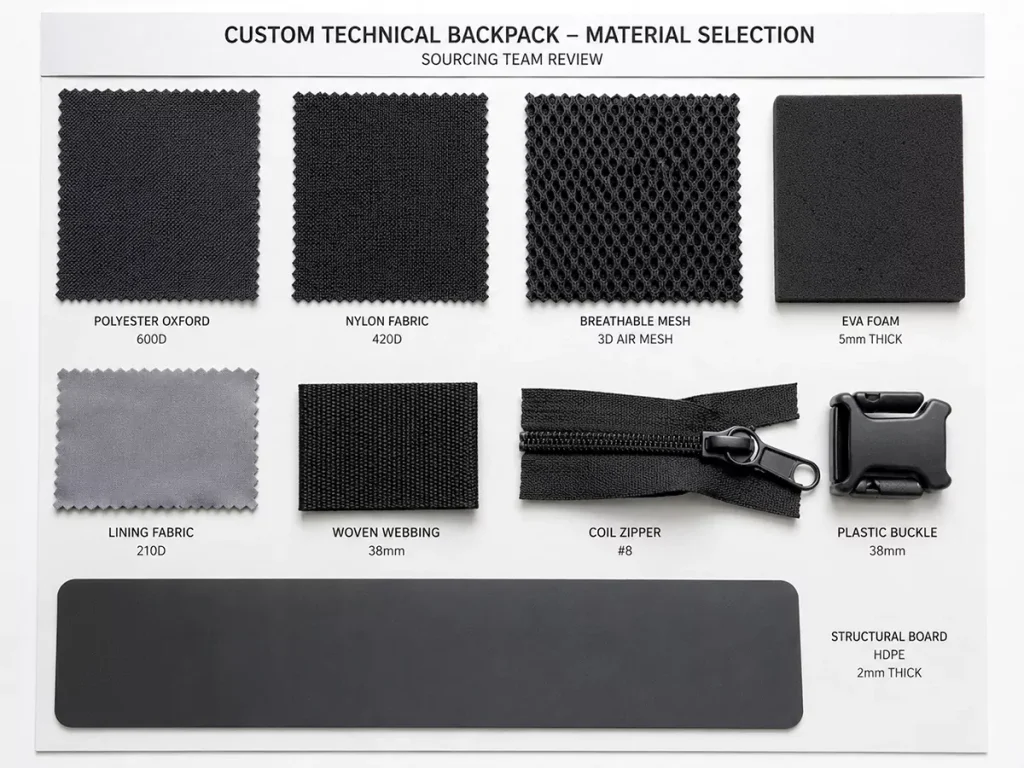
Material specifications are one of the easiest areas for misunderstandings, which is why material selection should be confirmed before sample approval.
Terms such as 600D polyester, 900D Oxford or nylon provide useful information, but they do not describe the entire material specification.
Fabric performance can also depend on yarn construction, fabric weight, weave, coating, backing and finishing.
The same applies to the other components of the backpack.
A proper material review may cover:
| Component | Details Worth Confirming |
|---|---|
| Exterior fabric | Composition, denier, weight, coating, finish |
| Lining | Polyester/nylon type, weight, color |
| Foam | Type, thickness and density |
| Structural board | PE board, PP board, EVA or other support |
| Zipper | Size, coil type, brand if specified |
| Buckles | Material, size, finish |
| Webbing | Width, thickness, material |
| Mesh | Type, stretch and breathability |
| Thread | Appropriate specification for construction |
| Logo | Material and application method |
If you need a custom Pantone color, ask whether the material must be custom dyed and whether that creates a separate material MOQ.
This matters because material MOQ and finished-product MOQ are not always the same thing.
For a first order, using an available material color can sometimes make production easier than developing a completely custom fabric color.
Also be careful with performance descriptions.
For example, using a coated fabric does not automatically make the entire backpack waterproof. Seams, zippers and construction also affect water protection.
If a specific performance standard matters to your project, define how it will be verified instead of relying on a broad marketing term.
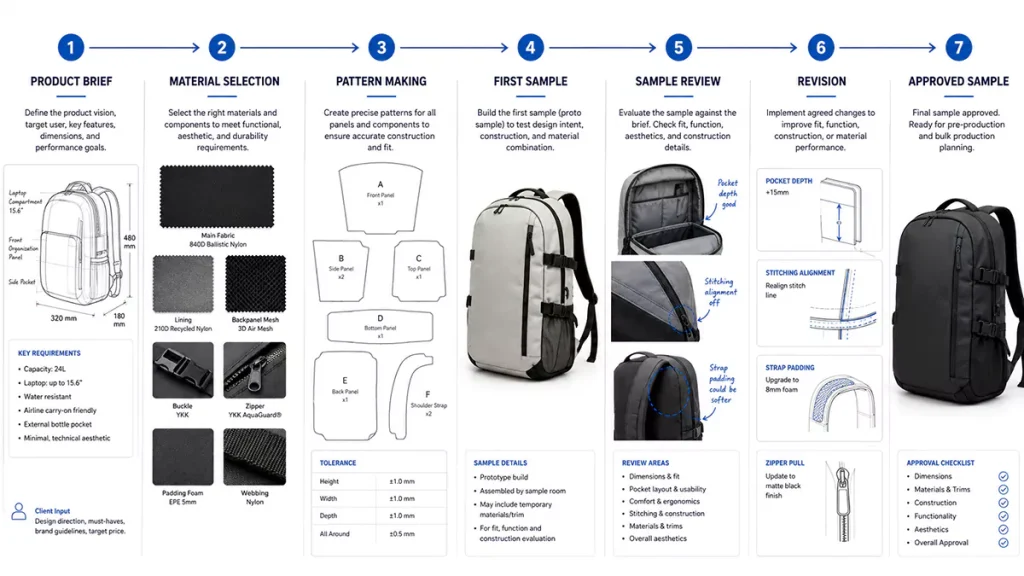
5. Use the Sample to Define the Product
For a custom backpack project, sample development is not just about producing a sales sample.
It should gradually become the physical reference for bulk production.
During sample review, look beyond the appearance.
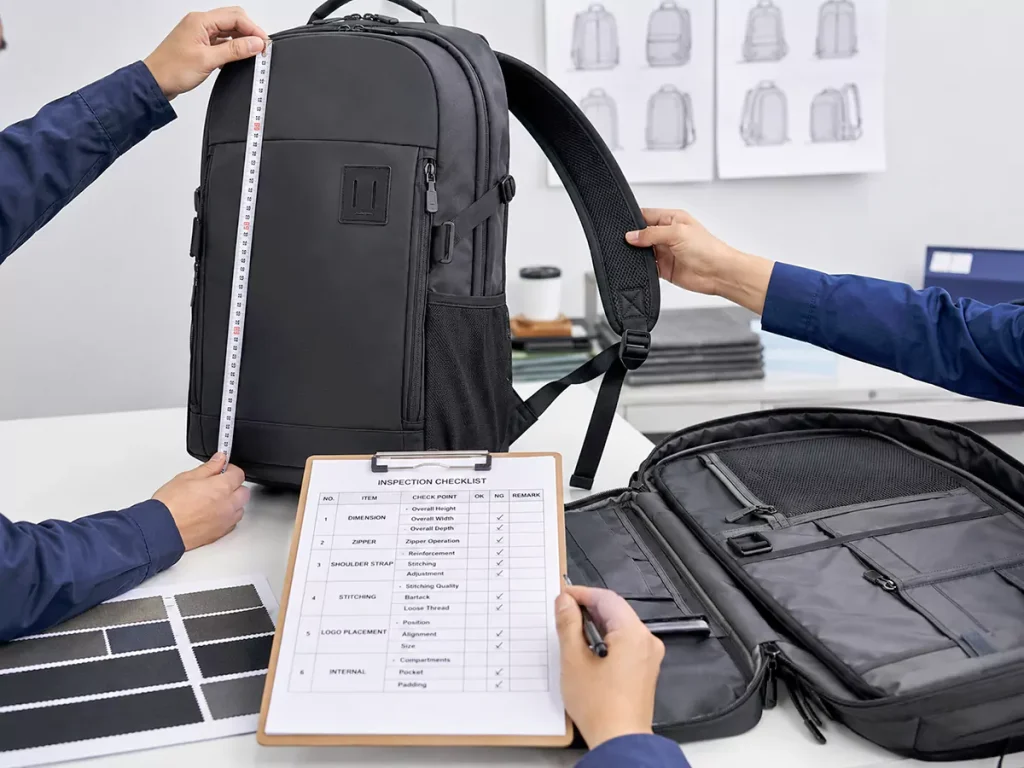
Check the dimensions, opening size, compartment arrangement, shoulder strap position, zipper operation, reinforcement, padding, logo position and actual usability.
If possible, put the intended contents inside the backpack.
A bag that looks correct when empty may behave very differently when loaded.
Pay particular attention to:
Load-bearing areas: shoulder strap connections, handles, bottom panels and other points under repeated stress.
Functional areas: zippers, buckles, hook-and-loop closures, elastic parts and removable components.
Protection: foam thickness, structural panels and the fit around sensitive equipment.
Branding: logo dimensions, position, color and production method.
Packing: how the backpack is folded and packed, especially if the structure contains foam or rigid reinforcement.
Every approved change should be recorded.
Do not rely on long chat histories as the only production specification.
Once the sample is approved, the factory should have a clear reference for the materials, construction, dimensions and branding that will move into bulk production.
For highly customized products, the safest approach is usually:
approve the product first, then confirm the final production specification and price based on the approved sample.
6. Understand What Actually Determines MOQ
Buyers often ask:
What is your minimum order quantity?
There is no useful answer without understanding the product.
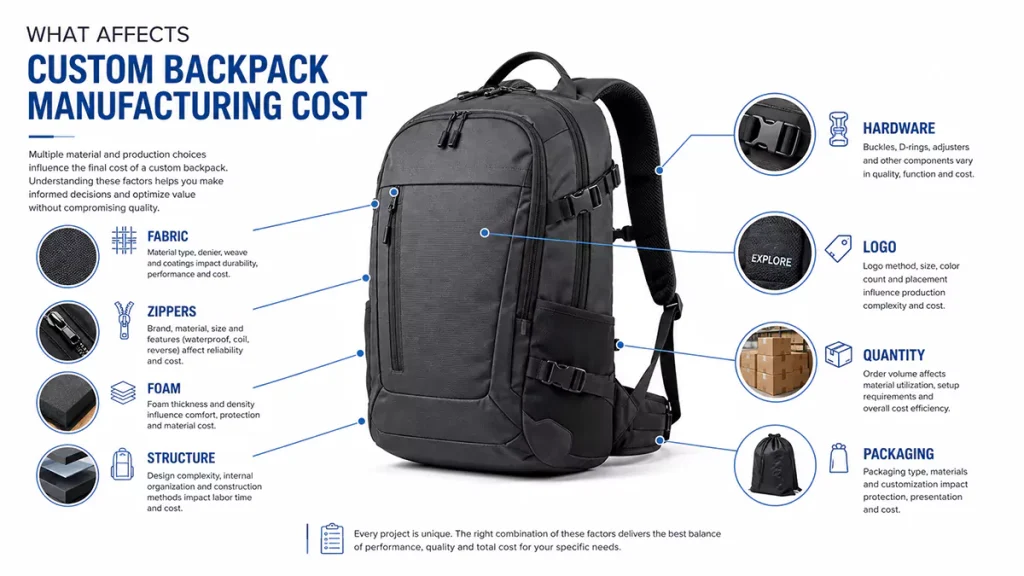
MOQ can be affected by the fabric, custom color, zipper, buckle, molded part, logo process, packaging and overall construction.
A manufacturer may be able to sew 100 backpacks, but a custom-dyed fabric supplier may require enough material for several hundred units.
Likewise, a custom metal accessory or molded rubber logo may have its own production requirement.
This is why a reliable custom backpack manufacturer should explain what is creating the MOQ, rather than simply giving you a number.
At Voufan Bags, custom bag projects commonly start from around 300 pcs, but the actual MOQ depends on the product, materials, color, logo, structure and sourcing requirements.
If your first order is relatively small, there may be practical ways to simplify production.
Using an existing material color, standard hardware, a simpler logo method or standard packaging can sometimes reduce unnecessary sourcing complexity.
The right solution depends on the project.
7. Compare Quotations on the Same Specification
The lowest unit price is not always the lowest-cost sourcing decision.
Before comparing two quotations, check whether they are actually based on the same product.
When evaluating a custom backpack manufacturer, make sure the quotation is based on the same material, construction and branding requirements.
Consider a backpack quoted by two manufacturers.
Supplier A may quote a lower price using a lighter lining, standard zipper, thinner foam and fewer reinforcement layers.
Supplier B may quote a higher price based on the construction described in your reference sample.
Both quotations could be technically valid, but they are not quotations for the same backpack.
A useful preliminary quotation should make the main assumptions clear.
For a customized project, confirm which items are included, such as the bag itself, logo, packaging, custom accessories, molds, testing or other development costs.
You can also request quantity tiers such as:
300 pcs / 500 pcs / 1,000 pcs
This helps you understand whether increasing the production quantity meaningfully changes the unit cost.
The final price should still be tied to the final approved specification.
8. Review the Factory's Quality Control Process
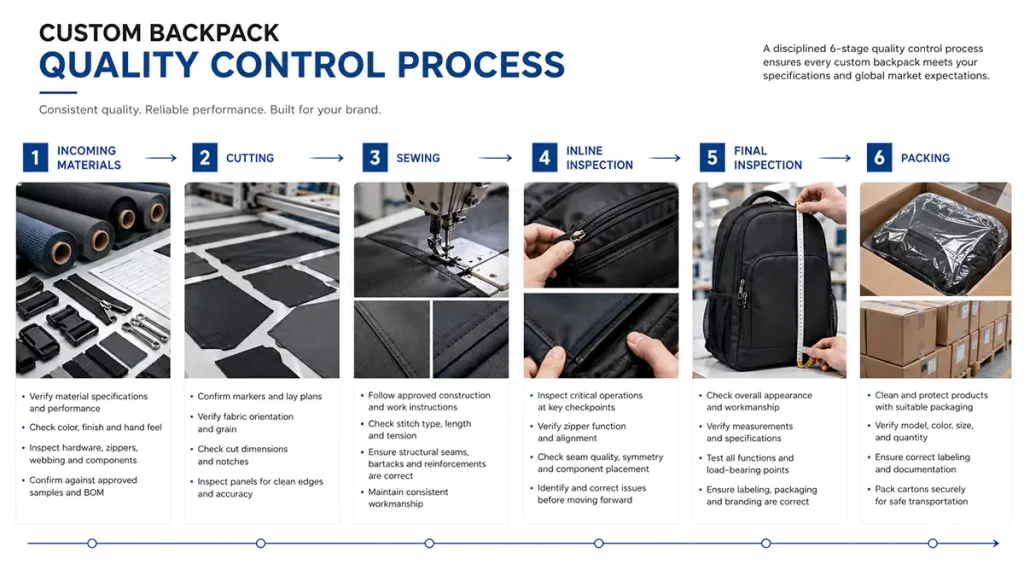
A practical quality control process should begin before the finished backpacks are packed into cartons.
Problems are easier to correct earlier in production.
A practical backpack QC process can include several checkpoints.
Material Inspection
The factory checks whether the fabrics, zippers, buckles, webbing, foam and other components match the approved requirements before they enter production.
Pre-Production Confirmation
The production team should understand the approved sample and the final specifications before cutting and sewing begin.
In-Process Inspection
Construction problems can be detected while the backpack is being assembled.
This is particularly important around reinforcement points, pocket positioning, zipper installation, binding and other details that become difficult to change later.
Finished Product Inspection
Completed backpacks can then be checked for workmanship, measurements, appearance, function, branding and packaging.
The exact inspection standard should reflect the product.
A lightweight promotional backpack and a heavy equipment backpack should not necessarily be evaluated in exactly the same way.
If a specific test matters — for example buckle strength, seam strength, zipper cycling, colorfastness or water resistance — discuss the test method before production.
Do not assume that every factory automatically performs every possible test on every backpack.
9. Pay Attention to How the Supplier Communicates
Communication is part of manufacturing control.
The person handling your project does not need to send long emails. They need to understand what has changed, what still needs confirmation and what could affect the product.
During the quotation and sampling stage, notice whether the supplier asks specific questions.
For example:
“Should this divider be fixed or removable?”
is more useful than:
“Please confirm the design.”
Likewise:
“This structure can probably be made, but we should verify the support during sampling.”
is more meaningful than:
“No problem.”
A reliable supplier should also distinguish between what has been confirmed and what is still an estimate.
This is particularly important for custom development because some construction details cannot be judged accurately until the first sample is assembled.
Good communication reduces assumptions.
And fewer assumptions usually mean fewer surprises during production.
10. Verify the Manufacturer Before You Place a Larger Order
A polished website alone does not prove manufacturing capability.
Before choosing a custom backpack manufacturer for an important project, verify the company behind the quotation.
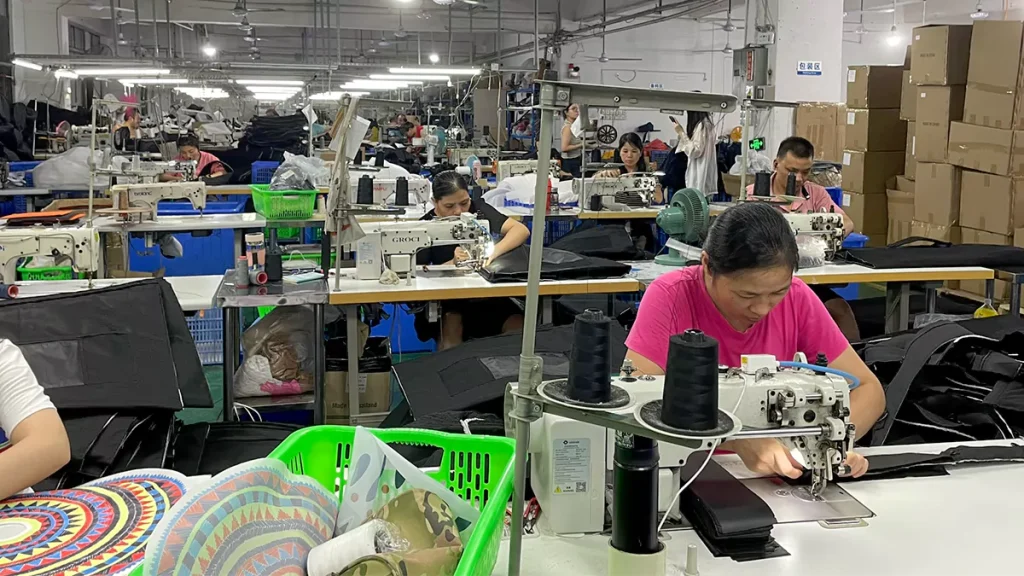
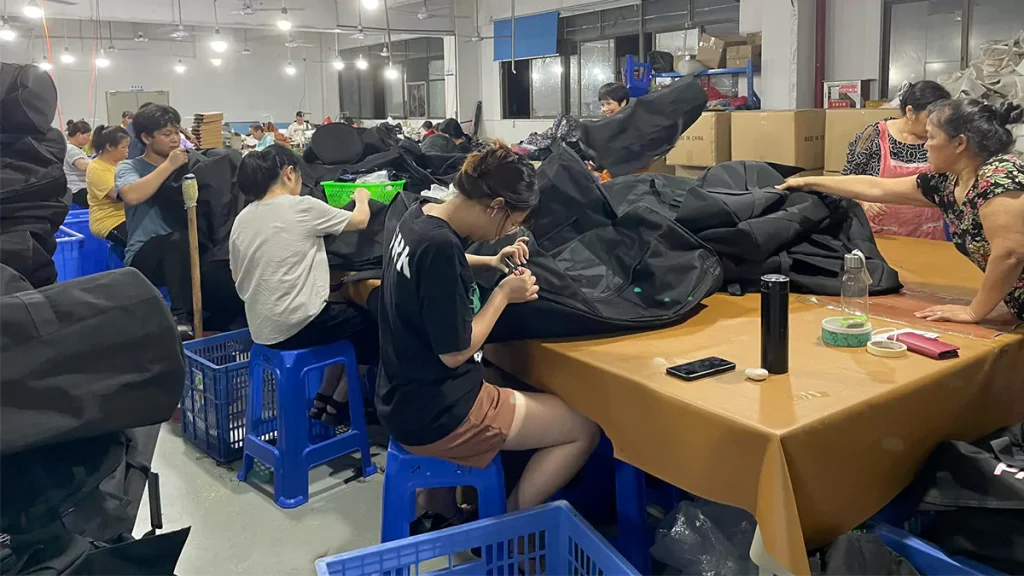
You can check the company name, business information, location and contact details. Ask to see the supplier’s manufacturing facility, relevant production areas, or arrange a factory video call when appropriate.
For larger or more complex programs, you may also want third-party inspections or other verification depending on your company’s purchasing procedure.
If your market requires specific testing or compliance documentation, confirm exactly what is relevant to the product.
For products sold in the EU, buyers should also check whether relevant materials or components are subject to REACH requirements.
Avoid asking only:
Do you have certificates?
Instead ask what you actually need.
For example, the requirement may relate to a particular material, chemical restriction, product application or testing standard.
The manufacturer should be able to discuss what is available and what may need additional testing.
For proprietary designs, also clarify how drawings, samples, logos and other customer information will be handled.
11. Compare Manufacturers With a Simple Scorecard
Once you have spoken with several suppliers, comparing them only by unit price becomes difficult.
A simple scorecard makes the decision more objective.
| Evaluation Area | Suggested Weight |
|---|---|
| Relevant backpack manufacturing experience | 15% |
| OEM/ODM development capability | 15% |
| Sample accuracy and revision process | 15% |
| Quality control | 15% |
| Material sourcing and specification control | 10% |
| Communication and technical understanding | 10% |
| MOQ and commercial fit | 10% |
| Production planning | 5% |
| Documentation / compliance support | 3% |
| Confidentiality and project protection | 2% |
| Total | 100% |
The weighting can change depending on your project.
For a simple promotional backpack, price and production speed may carry more weight.
For a technical backpack protecting valuable equipment, development capability, materials and QC may matter much more.
The purpose is not to find a factory that scores perfectly in every category.
It is to choose a manufacturer whose strengths match the risks of your project.
Warning Signs Worth Taking Seriously
A low quotation alone is not a warning sign. Neither is a high sample fee.
The issue is whether the supplier can explain what you are paying for and how the product will be developed.
More meaningful warning signs include a supplier confirming a complex design without asking any technical questions, giving a firm final price before the important specifications are known, changing material descriptions during the discussion, or repeatedly providing inconsistent information about MOQ and production.
You should also be cautious if changes agreed during sampling are not recorded, if the supplier pushes directly into mass production before the custom structure has been properly verified, or if performance and certification claims cannot be supported when you ask for details.
One of the most useful signals is simple:
Does the manufacturer point out production risks before you discover them yourself?
That tells you much more than a generic promise about quality.
Questions to Ask a Custom Backpack Manufacturer
Before choosing a supplier, you should be able to get clear answers to the following questions.
| Question | Why It Matters |
|---|---|
| Have you made backpacks with a similar structure? | Checks relevant experience |
| Can you develop from drawings, photos or an existing sample? | Checks OEM/ODM capability |
| Which parts of my design need clarification before sampling? | Tests technical understanding |
| Which materials do you recommend and why? | Tests sourcing knowledge |
| What determines the MOQ for this project? | Reveals material/accessory constraints |
| What is included in the sample fee? | Avoids misunderstanding |
| How are sample revisions handled? | Important for custom development |
| What changes could affect the final unit price? | Makes quotation assumptions clear |
| How do you control bulk production against the approved sample? | Checks production repeatability |
| What QC steps will be used for this backpack? | Checks quality planning |
| Are any special tests required for my application or market? | Identifies compliance risks |
| How are customer designs and project information protected? | Important for private-label projects |
A serious supplier should be comfortable discussing these topics.
They do not need to have an immediate answer to every technical question. Sometimes checking with the pattern maker, material supplier or production team is exactly the responsible thing to do.
Where Voufan Bags Fits Into a Custom Backpack Project
Voufan Bags is an OEM/ODM custom bag manufacturer based in Shenzhen, China.
Since 2008, we have supported brands, importers, wholesalers, distributors and private-label sellers with custom bag development, sampling, material sourcing, manufacturing and quality control.
For custom backpack projects, development can begin from reference images, drawings, an existing physical sample or a product concept.
Before sampling, we review the product structure, material requirements, dimensions, branding and other details that may affect manufacturing.
If a construction detail still needs to be tested, we prefer to verify it during sample development rather than make an assumption before the bag is built.
Our standard MOQ for many custom bag projects starts from around 300 pcs, although the final MOQ depends on the backpack design, materials, colors, logo method, structure and sourcing requirements.
For a new project, the most useful first step is not simply asking for the lowest unit price.
Send us the product information you already have, and we can first review whether the structure is practical and identify the details required for sampling and quotation.
Frequently Asked Questions
How do I find a reliable custom backpack manufacturer?
Start by looking for manufacturers with experience in a backpack category similar to yours. Then evaluate their OEM/ODM development capability, material knowledge, sampling process, MOQ, QC and communication. For a customized structure, use the sample to verify the manufacturer before committing to bulk production.
What is a typical MOQ for custom backpacks?
There is no universal MOQ. It depends on the fabric, colors, accessories, logo method, packaging and construction. Voufan Bags commonly starts custom bag projects from around 300 pcs, with the final MOQ confirmed after reviewing the specification.
Do I need a tech pack to make a custom backpack?
Not necessarily.
A factory can often begin reviewing a project from reference photos, drawings, an existing sample or a clear product concept. However, more detailed technical information becomes increasingly important as the project moves toward sampling and production.
Should I make a sample before ordering custom backpacks in bulk?
For a new or modified backpack structure, yes.
Sampling allows you to check dimensions, materials, compartments, comfort, construction, branding and usability before those decisions are repeated across hundreds or thousands of pieces.
What affects the price of a custom backpack?
The main factors usually include quantity, fabric, lining, foam, structural reinforcement, zipper, hardware, webbing, logo method, accessories, packaging and testing requirements.
The construction can be just as important as the exterior material.
What is the difference between OEM and ODM backpack manufacturing?
OEM normally means manufacturing a backpack based on the buyer’s design or specification.
ODM involves more development support from the manufacturer, which may include adjusting the structure, materials or product concept before production.
In practice, many custom backpack projects contain elements of both.
How can I check whether a backpack manufacturer is a real factory?
Check the company’s business information and manufacturing location, review real production evidence and arrange a video factory visit if necessary. For larger projects, buyers can also use third-party audits or inspections according to their purchasing procedures.
What should I send to get a custom backpack quotation?
Send the backpack type, estimated quantity, dimensions, materials if known, colors, logo requirements, structural requirements, packaging and destination market.
Reference images, drawings or an existing sample are especially helpful.
Final Thoughts
Choosing a reliable custom backpack manufacturer is less about finding the supplier that says yes fastest and more about finding one that understands what needs to be confirmed.
A good manufacturing process should gradually remove uncertainty.
The product concept becomes a defined structure. Materials become confirmed specifications. The first prototype becomes an approved sample. The approved sample becomes the reference for bulk production.
If a manufacturer can manage those transitions clearly, the risk of surprises later in production becomes much lower.
The right custom backpack manufacturer should reduce uncertainty as the project moves from concept to sample and bulk production.
Developing a new backpack project?
Voufan Bags can review projects from drawings, reference images, existing samples or product concepts and help determine the appropriate material, sampling and manufacturing route.