
OEM vs ODM Bag Manufacturing: A CompleteGuide for Brands
OEM vs ODM Bag Manufacturing Explained
Navigating the global supply chain requires precision, especially when launching a new product line. If you are sourcing custom bags from overseas, you will immediately encounter two critical acronyms: OEM and ODM. Choosing the right path determines your lead times, tooling costs, and ultimate control over your intellectual property.
Understanding the differences in OEM vs ODM bag manufacturing is the first step to building a profitable, scalable product line. Many brand owners waste thousands of dollars and months of development time simply because they select the wrong manufacturing model for their specific business stage.
This guide breaks down exactly how these two manufacturing models work in the real world of soft goods production. We will cover the advantages, cost structures, and timelines associated with both approaches. Whether you are an Amazon seller scaling a private label brand or an enterprise medical company needing sterile equipment cases, you will leave with a clear roadmap for your next sourcing project.
What OEM Bag Manufacturing Really Means
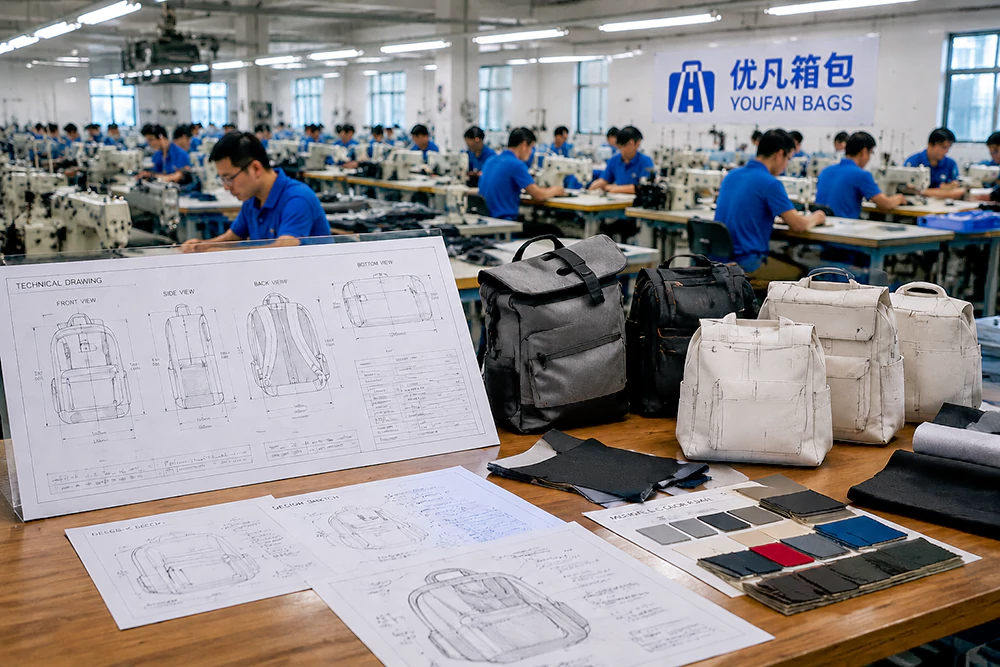
OEM stands for Original Equipment Manufacturer. In the soft goods industry, an OEM bag manufacturer takes your exact design specifications and turns them into a physical product. You provide the blueprints, and the factory provides the labor, machinery, and material sourcing to execute your vision.
Under the OEM model, the brand owner maintains complete control over the product development process. You will typically supply the factory with a “tech pack” containing detailed 2D or 3D CAD drawings, material requirements, hardware specifications, and exact dimensions. The factory acts strictly as the builder, not the designer.
This is the standard model for established brands that employ in-house product designers. If you have invented a completely novel backpack suspension system or require a highly specialized custom medical bag, you need an OEM relationship. The factory builds your exact product, and you own all the intellectual property rights to that design.
What ODM Bag Manufacturing Really Means
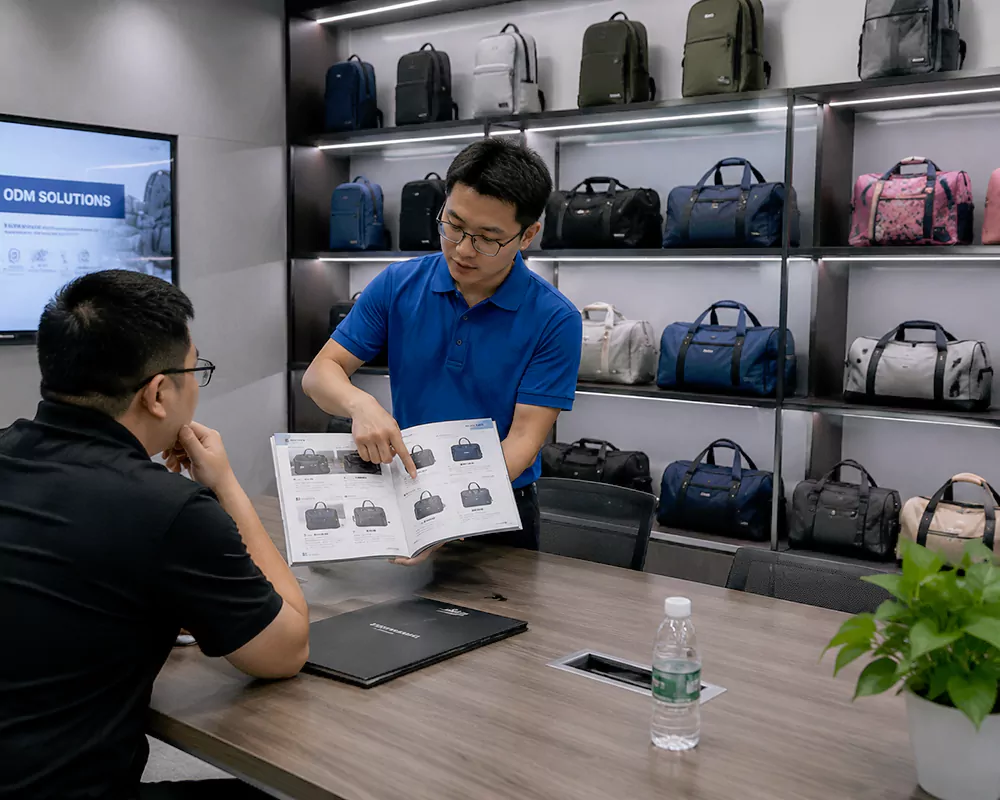
ODM stands for Original Design Manufacturer. An ODM bag manufacturer acts as both the designer and the producer. In this model, the factory has already invested the R&D to develop, test, and manufacture a catalog of bag designs. As a buyer, you select an existing product from their catalog and rebrand it as your own.
This process is commonly known as white labeling or private labeling. When you work with an ODM bag factory in China, you bypass the lengthy prototyping phase. The factory already owns the patterns, knows the material yields, and has the supply chain established for that specific bag.
While you do not own the core design, you can usually request minor modifications. You might change the fabric color, swap out the zipper pulls, or add your custom logo via embroidery, rubber patches, or screen printing. This model is ideal for companies that excel at marketing and distribution but lack dedicated industrial design teams.
OEM vs ODM Bag Manufacturing: Key Differences
To make an informed sourcing decision, you must understand how risk and responsibility are divided. The fundamental difference in OEM vs ODM bag manufacturing comes down to who handles the research and development.
Below is a detailed comparison of how these two models stack up against each other across critical business metrics.
| Feature | OEM (Original Equipment Manufacturer) | ODM (Original Design Manufacturer) |
| Product Ownership | Brand owner holds all intellectual property. | Factory owns the core design. |
| Design Responsibility | Brand owner provides full tech packs and specs. | Factory provides existing, tested designs. |
| Typical MOQ | High (Usually 500 – 1,000+ units per color). | Lower (Often 200 – 500 units per color). |
| Development Cost | High (Requires pattern making, tooling, multiple samples). | Low (Patterns and tooling already exist). |
| Lead Time | Long (3-6 months from concept to mass production). | Short (30-60 days for production and branding). |
| Branding Options | Limitless (Fully customized to brand guidelines). | Restricted to surface branding (logos, colors, tags). |
| Market Exclusivity | 100% exclusive. Competitors cannot buy this design. | Not exclusive. Competitors may sell identical shapes. |
| Margin Potential | High (Unique products command premium pricing). | Moderate (Requires competing on brand and price). |
Advantages of OEM Bag Manufacturing
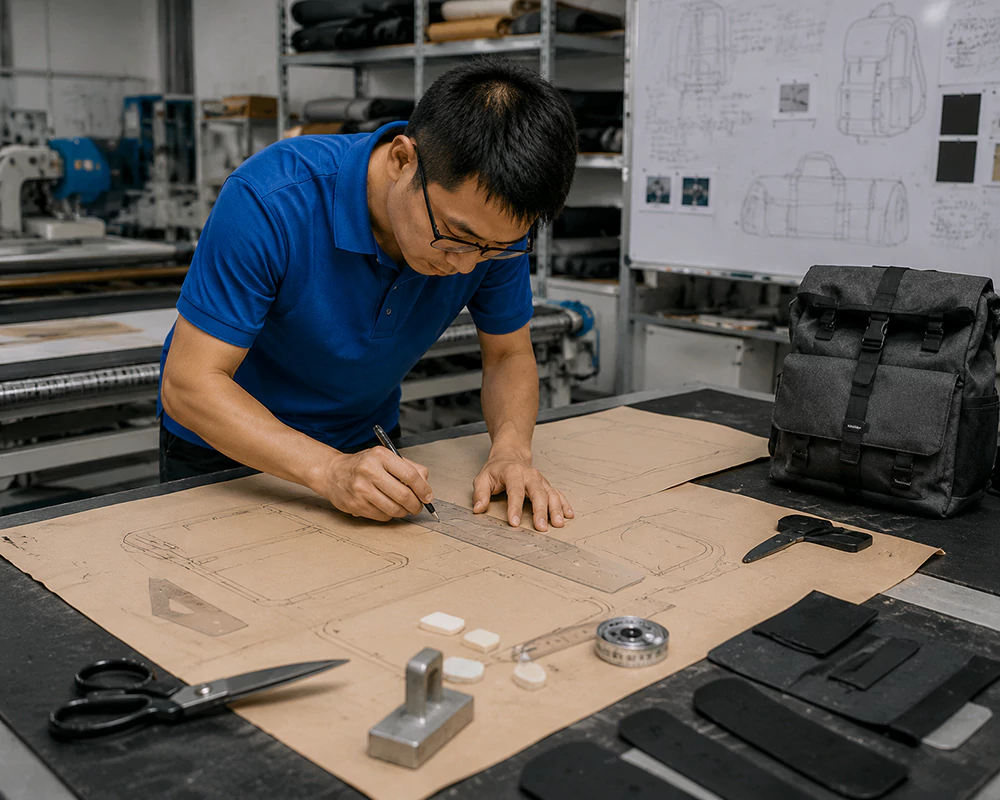
Partnering with an OEM bag manufacturer provides absolute creative control over your product line. When you dictate every seam, zipper, and fabric choice, you can engineer a product that perfectly solves your target customer’s pain points.
Total IP Protection: Your proprietary designs belong to you. A reputable manufacturer will sign an NNN (Non-Disclosure, Non-Use, Non-Circumvention) agreement, ensuring your unique features are never sold to competitors.
Unrestricted Customization: You are not limited by existing molds or patterns. If you need a specialized tactical backpack with laser-cut MOLLE panels and specific waterproof zippers, OEM makes it possible.
Premium Brand Positioning: Because your product is completely unique in the marketplace, you avoid the “race to the bottom” on pricing. Unique features allow for higher retail margins.
Seamless Integration: For companies selling highly technical gear, the bag must often integrate with other proprietary hardware. OEM ensures exact tolerances are met for a perfect fit.
Advantages of ODM Bag Manufacturing
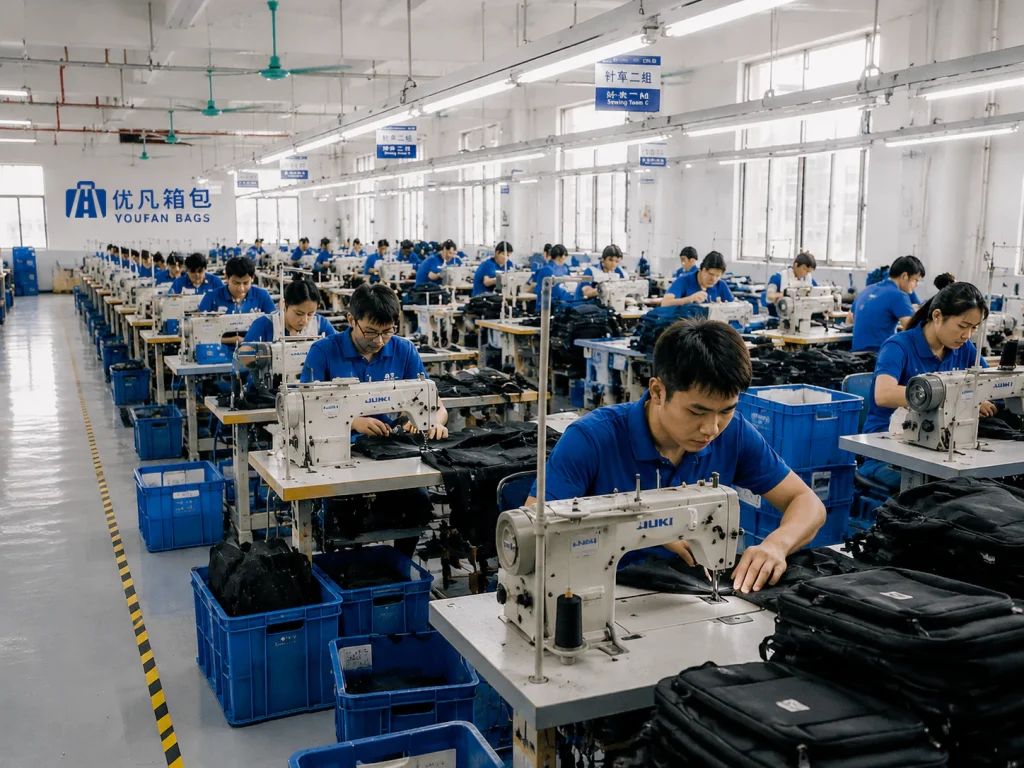
Working with an ODM bag factory in China is the fastest route to market. For businesses that want to focus capital on customer acquisition rather than product development, the ODM route minimizes upfront risk.
Rapid Deployment: Because the factory already has the patterns and material supply chains dialed in, you skip months of prototyping. You can often go from order placement to shipping within 45 days.
Lower Financial Barrier: You avoid paying for custom tooling, costly mold fees for unique hardware, and multiple rounds of sample revisions.
Proven Quality: ODM bags are typically mature products. The factory has already ironed out production errors, seam failures, and material flaws through previous production runs.
Lower Minimum Order Quantities: Factories are more willing to accept smaller initial orders for ODM products because they do not have to recalibrate their entire production line to run your batch.
Cost Comparison: OEM vs ODM
Capital allocation is usually the deciding factor when choosing between OEM vs ODM bag manufacturing. OEM is significantly more capital-intensive upfront. You must budget for pattern creation (typically $100-$300 per style), multiple prototyping rounds, and custom tooling if you require branded hardware or molded EVA panels (which can run from $500 to $3,000+).
ODM flips this script. Your upfront costs are negligible. You may pay a small fee for a pre-production sample to verify your logo placement and fabric color, but the heavy R&D costs are entirely absorbed by the factory. Your capital goes directly toward purchasing inventory.
However, the unit cost dynamics shift at high volumes. If you are ordering 10,000 units, an OEM bag manufacturer can often value-engineer the product. By working directly with you, they can suggest minor design tweaks that shave pennies off the manufacturing cost of each unit, leading to massive savings at scale.
Timeline Comparison: OEM vs ODM
Time is money in physical product retail. The ODM timeline is highly compressed. Once you select a private label bag production model, you choose your colors, submit your logo file, and wait 10-15 days for a branded sample. Upon approval, mass production typically takes 30-45 days. You can realistically have inventory ready for sea freight in under two months.
The OEM timeline requires patience and a robust project management system. The initial tech pack review and material sourcing phase takes 2-3 weeks. First-round sampling takes another 2-3 weeks. It is rare for a first sample to be perfect; you will likely need a second or third revision, adding 4-6 weeks.
Once the final OEM golden sample is approved, raw material purchasing for mass production begins. For complex custom backpacks or specialty cases, mass production takes 45-60 days. In total, a scratch-built OEM project typically requires 4 to 6 months before the goods are ready to leave the port.
Which Option Is Better for Startups
For most bootstrapping startups and solo Amazon sellers, ODM is the clear winner. When you are testing a new niche, cash flow and speed are your most valuable assets. By utilizing private label bag production, you can test market demand without sinking $10,000 into R&D and tooling.
Startups should leverage an ODM bag factory in China to launch a minimally viable product. If you find success selling a white-labeled duffel bag, you can gather customer feedback through reviews.
Once you have consistent cash flow and a deep understanding of what your customers actually want, you can graduate to the OEM model. You can then take your customer feedback to an OEM custom bag manufacturer to build version 2.0 from scratch, creating a protective moat around your brand.
Which Option Is Better for Established Brands
Established brands, enterprise companies, and specialized hardware manufacturers must almost exclusively rely on OEM. If you are a recognized brand, your customers expect a cohesive design language across your entire product ecosystem. You cannot achieve this by slapping your logo on a generic catalog item.
Furthermore, established brands face higher risks of counterfeiting. By controlling the IP through an OEM relationship, you maintain legal leverage to strike down knock-offs. The OEM model also allows established companies to source highly specialized proprietary materials, such as custom-milled Cordura fabrics or specialized antimicrobial liners, which are unavailable in standard ODM catalogs.
When your brand equity is high, the longer lead times and higher R&D costs of custom bag manufacturing are easily justified by the premium retail price you can command in the market.
How Outdoor, Medical, Pet, Tool and Cooler Bag Brands Use OEM and ODM
The choice between OEM vs ODM bag manufacturing varies wildly depending on the industry. Different sectors have vastly different regulatory, durability, and customization requirements.
Here is how brands across six major verticals navigate their bag sourcing strategies.
Outdoor Sports Bags
The outdoor industry is highly competitive, driven by technical innovation. A custom sports bag manufacturer must balance extreme durability with lightweight materials.
OEM Usage: Top-tier brands use OEM to develop proprietary hydration systems, ultra-lightweight internal frames, and custom waterproof seam-taping processes. Check out our Outdoor Sports Bags capabilities for advanced technical packs.
ODM Usage: Entry-level camping brands often use ODM for basic daypacks and simple dry bags, changing only the fabric colors to match seasonal trends.
Medical Bags
Healthcare equipment requires strict adherence to industry standards. A custom medical bag manufacturer must source materials that are easy to sanitize, highly durable, and organized for emergency response.
OEM Usage: This sector relies almost entirely on OEM. First responder jump bags, oxygen tank carriers, and custom surgical kit cases require precise interior compartmentalization that generic bags cannot provide. Explore our Medical & Healthcare Bags development process.
ODM Usage: Rarely used, except for very basic, low-tier first aid pouches distributed as promotional items.
Pet Carrier Bags
The pet product industry has exploded, with consumers demanding high-fashion aesthetics combined with functional safety for their animals.
OEM Usage: Premium brands use OEM to design airline-compliant carriers with specialized mesh ventilation, structural wireframes, and custom safety tethers. Review our Pet Carrier Bags manufacturing standards.
ODM Usage: Mid-market Amazon sellers frequently use ODM for standard soft-sided carriers, adding custom printed fabrics or upgraded fleece pads to differentiate.
Tool Bags
Professional tradesmen demand rugged durability. Tool bags must withstand sharp objects, heavy weight loads, and abrasive environments.
OEM Usage: Major tool brands use OEM to integrate custom molded hard-bottom bases, heavy-duty riveted stress points, and exact pocket dimensions tailored to specific toolsets. See our heavy-duty Tool Bags & Equipment Cases.
ODM Usage: Hardware store house-brands often use ODM for basic canvas tool totes and simple zipper pouches
Commercial Cooler Bags
Thermal performance is the primary metric for soft coolers. Success depends entirely on the insulation materials and construction techniques.
OEM Usage: Brands competing with Yeti or RTIC use OEM to utilize high-density closed-cell foam, RF-welded seams, and airtight waterproof zippers for multi-day ice retention. Learn more about our Commercial Cooler Bags technology.
ODM Usage: Promotional companies and grocery chains use ODM for basic foil-lined delivery bags meant for short-term temperature control.
Protective Cases
From drones to delicate electronics, protective cases require precise engineering to absorb shock and prevent moisture ingress.
OEM Usage: Tech brands use OEM to create custom die-cut EVA foam inserts that perfectly cradle their hardware, wrapped in durable nylon or PU shells. Discover our capabilities in Protective Cases & Specialty Bags.
ODM Usage: Accessory sellers use ODM for generic laptop sleeves and basic tablet folios where exact hardware integration is not necessary.
Questions to Ask Before Choosing a Bag Manufacturer
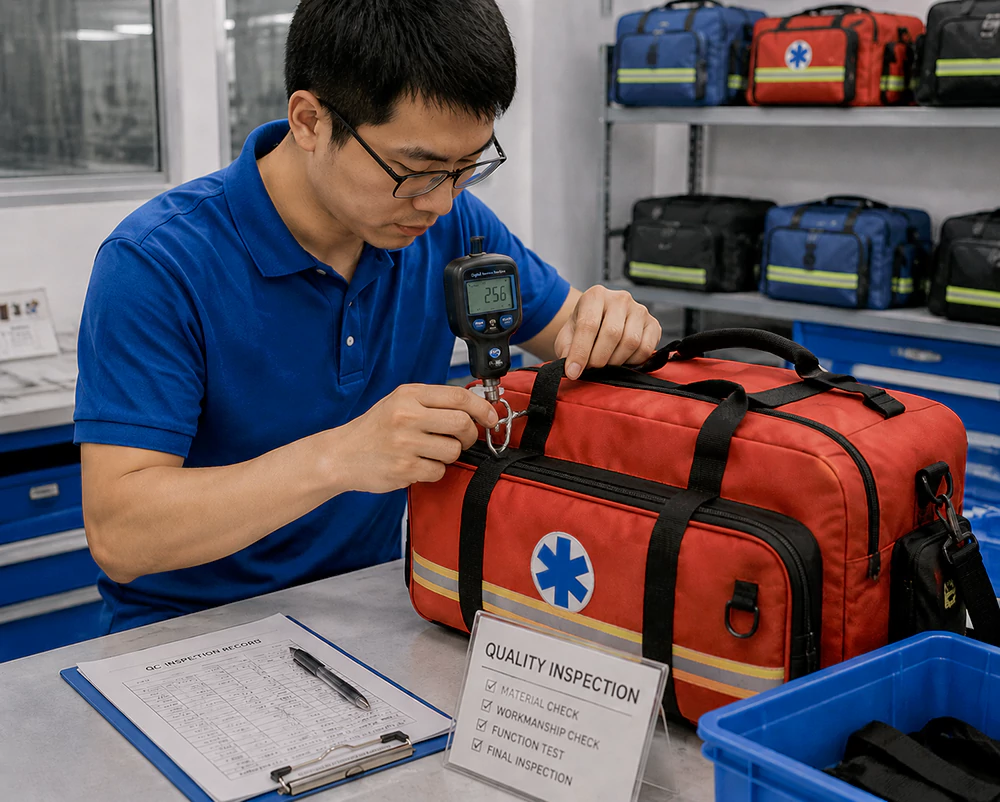
Selecting the right partner is more critical than selecting the right manufacturing model. Not all factories are equipped to handle both models efficiently. When evaluating an OEM backpack factory or a private label supplier, use this buyer checklist to vet their capabilities:
The Manufacturer Evaluation Checklist:
Are you a trading company or the direct manufacturer?
Do you have an in-house design and pattern-making team for OEM projects?
What is your standard MOQ for ODM vs OEM orders?
Can you provide a portfolio of bags you have manufactured in my specific niche?
What is your protocol for protecting client Intellectual Property?
Do you have a dedicated English-speaking account manager?
What are your standard payment terms for tooling, sampling, and mass production?
Can you accommodate third-party quality control inspections (like SGS or AsiaInspection) before shipment?
How to Evaluate a Reliable OEM ODM Bag Factory
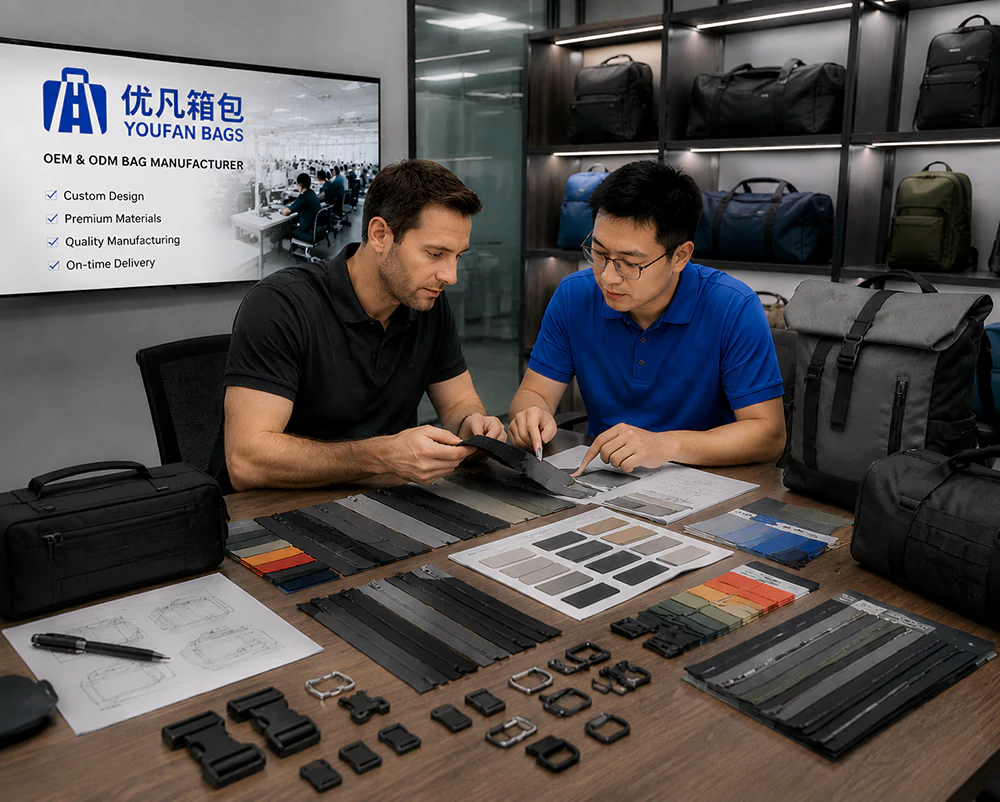
Finding a supplier on Alibaba is easy; finding a true strategic manufacturing partner takes work. If you are serious about your supply chain, you must evaluate a factory across several operational pillars before wiring a deposit. If you are looking for a reliable partner, you can learn more About Us and our operational standards.
Sampling Accuracy
A factory’s ability to interpret a tech pack is their most important skill. Do they ask clarifying questions about your design, or do they blindly make a sample that fails? A reliable factory will act as an advisor, pointing out potential manufacturing flaws in your design before cutting fabric.
Material Sourcing Network
A bag factory is only as good as its raw material suppliers. Top-tier factories are located in major manufacturing hubs (like Quanzhou or Guangzhou) with deep local networks. They should be able to quickly source YKK zippers, Duraflex hardware, and specialized fabrics like Cordura or ripstop nylon.
Quality Control Systems
Ask for their AQL (Acceptable Quality Limit) standards. A professional factory will have an incoming material inspection (IQC), in-process quality control (IPQC), and a final quality control (FQC) check. They should willingly accept and welcome your third-party inspectors.
Communication and Transparency
Language barriers and time zone differences can kill a project. You need an account manager who communicates proactively. If there is a delay in sourcing a specific buckle, they should tell you immediately, not wait until the deadline is missed.
Certifications and Compliance
Depending on your market, you may need specific certifications. Ensure the factory complies with REACH (for European markets) or Prop 65 (for California). If you are sourcing medical or children’s bags, check for ISO 9001 and appropriate ethical audit reports like BSCI or Sedex.
Frequently Asked Questions
Is it cheaper to do OEM or ODM?
ODM is significantly cheaper upfront because you bypass R&D, pattern making, and custom tooling costs. However, at high volumes (10,000+ units), an optimized OEM design can yield a lower per-unit cost through value engineering.
Can I patent an ODM bag?
No. Because the factory owns the original design and likely sells variations of it to other buyers, you cannot claim a utility or design patent on the core structure. You can only trademark your specific logo and brand name.
Do I need a tech pack for ODM?
No, a full tech pack is not required for ODM. You only need to provide your logo files, brand color guidelines, and specific placement instructions for your branding elements.
How long does an OEM bag sample take?
An initial OEM sample typically takes 14 to 21 days after the tech pack and raw materials are finalized. However, expect to do 2 or 3 revisions, meaning the total sampling phase can take 6 to 8 weeks.
What is an NNN agreement?
An NNN agreement stands for Non-Disclosure, Non-Use, and Non-Circumvention. It is a legal contract essential for OEM manufacturing in China to prevent the factory from stealing your design, using it for themselves, or selling it directly to your customers.
Can I switch from ODM to OEM later?
Absolutely. Many successful brands start with ODM to test market viability and generate cash flow. Once established, they hire an industrial designer and transition to OEM to create proprietary products.
Who owns the mold in OEM manufacturing?
If you pay the upfront tooling fees (mold fees) for custom hardware, EVA panels, or rubber logos, you own the mold. The factory merely stores it for your production runs. Ensure this is explicitly stated in your manufacturing contract.
Can an ODM factory make custom changes to a bag?
Yes, up to a point. Minor changes like swapping fabrics, changing zipper pulls, or adding a pocket are usually acceptable. If you request fundamental changes to the bag’s shape or internal structure, it becomes an OEM project requiring new patterns.
Are minimum order quantities (MOQs) strictly enforced?
MOQs are usually tied to raw material minimums, not the factory’s sewing capacity. If you choose a standard black nylon, the factory might lower the MOQ. If you want a custom-dyed fabric, you must meet the fabric mill’s strict MOQ.
How do I protect my brand quality when manufacturing overseas?
Never skip the Golden Sample process. Once a final sample is approved, both you and the factory sign and date it. Use a third-party QC agency to inspect mass production against this exact Golden Sample before you authorize final payment.
Final Thoughts
The decision between OEM vs ODM bag manufacturing ultimately dictates your brand’s trajectory. If speed to market and cash preservation are your top priorities, leverage the ODM model to launch lean and fast. If you are building a legacy brand centered on unique intellectual property, premium pricing, and exact specifications, OEM is the only viable path.
The most successful brands view their manufacturers not merely as vendors, but as strategic supply chain partners. Whether you are developing a technical outdoor pack or sourcing a line of corporate travel luggage, thorough vetting, clear communication, and rigorous quality control are the keys to a profitable production run.
If you are ready to take your product line from concept to mass production, our team of engineering and sourcing experts is ready to assist. Contact Us today to discuss your next custom bag project.