
Outdoor product development / Buyer guide
Best Hydration Vest Features for Trail Running
A brand buyer’s guide to fit, hydration access and sample approval.
VOUFAN BAGS / OEM & ODM DEVELOPMENT / 500+ UNIT PROJECTS
The most useful hydration vest features are a stable loaded fit, accessible hydration, secure storage and comfortable contact surfaces. For brands developing a custom trail running vest, these features need to work together across the intended size range.
A sample can look right on a table yet reveal problems when the flasks are half empty, the rear compartment is packed or the wearer reaches for a phone. Before choosing fabrics and adding pockets, define what the runner will carry—and how the vest should behave with that load.
Choose Hydration Vest Features Around the Intended Load
Build the product brief around a realistic packing list. Include the hydration system, phone, nutrition, clothing and any equipment the target customer is expected to carry.
Keep gear capacity and water capacity separate in your specifications. A storage-volume claim does not tell buyers which reservoir fits or how much space remains once it is installed.
For race-focused products, check the intended event’s current equipment requirements before finalizing the layout. Do not describe a vest as suitable for every race.
| Product direction | Features to prioritize | Tradeoff to review |
|---|---|---|
| Minimal training vest | Compact storage, front hydration access, simple adjustment | Limited room for extra clothing |
| General trail running vest | Secure phone storage, accessible nutrition, adjustable rear load | More pockets add construction and inspection work |
| Longer-outing vest | Defined gear space, hydration compatibility, load compression | Performance must be checked both full and partly empty |
| Pole-carrying vest | Reachable attachment points, secure retention, protected contact areas | Stored poles may interfere with pockets or arm movement |
These are development directions, not fixed capacity recommendations. Confirm the actual load before selecting a pattern.
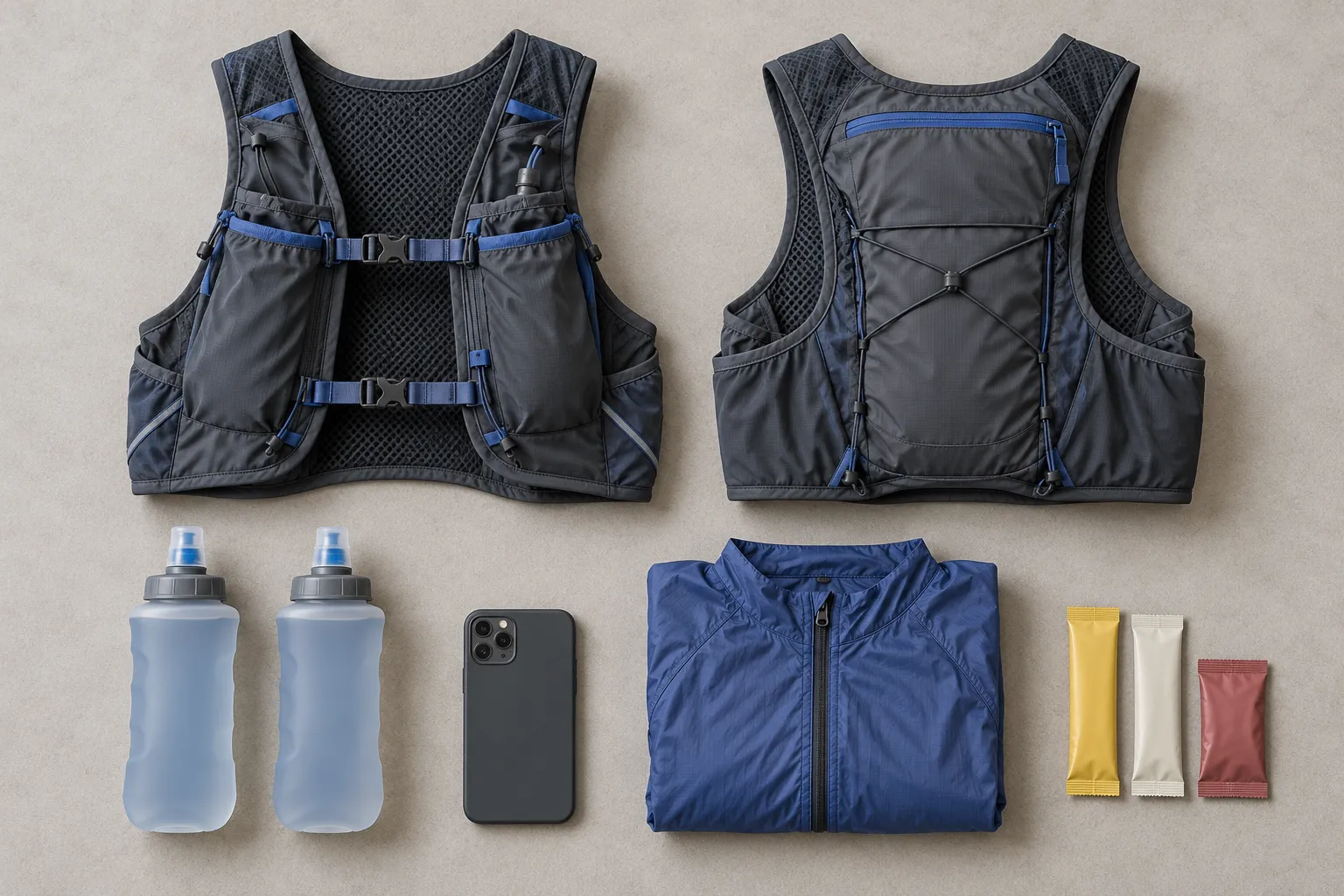
1. Fit That Remains Stable as the Load Changes
Prioritize loaded fit over the appearance of an empty vest. Salomon’s running backpack guide identifies body fit and movement control as central considerations when choosing a running pack.
For a private-label project, convert “good fit” into details that can be checked:
- Chest measurement range and where to measure it.
- Vest body length and lower-edge position.
- Front closure position and adjustment range.
- Side adjustment, if included.
- Fit with the intended clothing layers.
Evaluate full flasks, partly emptied flasks and a reduced rear load. Watch for movement, closure slippage, pressure points and interference with arm swing.
Avoid treating extra adjustment as a substitute for a developed size range. A vest tightened to its limit may still place the pockets incorrectly. Fit samples should include people with different torso lengths and chest shapes within the intended customer group.
For online sales, provide a measurement diagram based on the approved product. Generic S/M/L labels give customers too little information.
2. Flask Pockets Matched to the Actual Flask
Specify the flask model before approving the pocket pattern. Nominal volume alone does not establish compatibility: flask shape, height and cap geometry also matter. Salomon’s hydration flask guide likewise advises checking that the flask fits its carrying system.
During sampling, check whether the wearer can remove and replace the flask without excessive effort. Then repeat the check with the flask partly empty.
A useful pocket review includes:
- Opening stretch and recovery.
- Pocket depth and valve position.
- Retention-loop placement.
- Flask movement during running.
- Access when neighboring pockets are occupied.
A tight opening can improve retention but make reinsertion difficult. A loose pocket may work with a full flask and lose support as it empties.
If flasks are included in the retail package, identify the exact supplied component. If they are excluded, state compatibility clearly rather than suggesting that every similarly sized flask will fit.
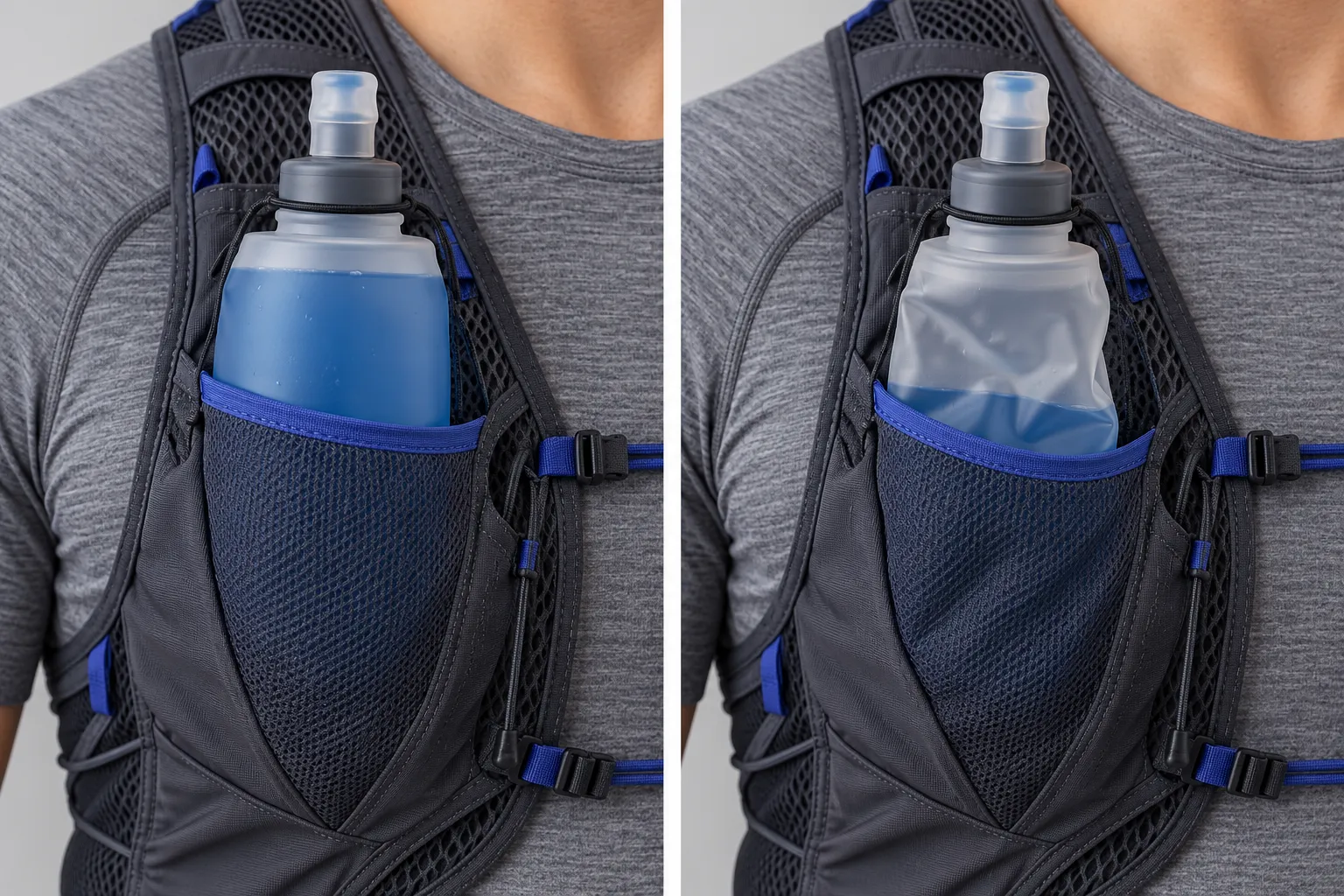
3. Reservoir Support With Clear Compatibility
Include a reservoir compartment when the intended use calls for it. Adding a sleeve without checking the complete system leaves important questions unresolved.
Specify the reservoir’s dimensions, filled shape, suspension method and hose route. Load the rear compartment at the same time: a reservoir that fits an otherwise empty vest may compete with the intended gear.
Check that the hose remains accessible and does not pull against the wearer’s neck. Review how the reservoir is removed, refilled and reinstalled.
The quotation should distinguish between a reservoir-compatible vest and a vest supplied with a reservoir. If drinking components are included, agree on the documentation and verification needed for the destination market before approving the package.
4. Contact Materials and Seams That Deserve Wear Testing
Select body-contact materials through comparison and wear trials, rather than appearance alone.
Ask for identified fabric samples covering composition, weight, stretch direction and finish. Compare the assembled construction as well as the fabric swatch. Binding, seam allowances, labels and reinforcement can change how a soft material feels against the body.
Pay particular attention to the neckline, underarm edges, shoulder seams and lower front corners. Include damp-condition wear trials and checks after the proposed care process.
Do not assume a visible mesh structure proves breathability, or that lightweight fabric establishes finished-product comfort. Claims such as quick-drying, abrasion-resistant or chafe-free require appropriate evidence; otherwise, use a narrower description.
Also separate fabric properties from pocket protection. A water-resistant panel does not establish that a sewn phone pocket is waterproof.
5. Pockets That Work With Both Hydration and Gear Loaded
Approve the pocket layout with its intended contents inside. Counting pockets says little about whether they are usable.
A phone pocket should accommodate the agreed device dimensions, including a case if that is part of the brief. Check closure access and whether the phone presses against a flask or the wearer.
For nutrition and small-item pockets, review retention and reach. An opening that is convenient when standing still may need a different shape or closure once movement is introduced.
Reserve secure storage for items that must not fall out. Do not assume every pocket needs a zipper: each closure changes weight, handling, cost and inspection requirements.
For Amazon and other ecommerce listings, photograph the approved pocket layout with representative contents. Make included accessories and compatible accessories easy to distinguish.
6. Optional Features That Earn Their Place
Pole attachments, reflective details and additional compression should solve a defined problem.
For pole storage, use the intended folded pole dimensions and check insertion, retention and clearance. Test whether the stored poles block another pocket or contact the wearer.
For reflective details, review placement on the worn vest, including with pockets loaded. Avoid implying that a reflective logo establishes a certified visibility or safety performance.
Check branding methods on the actual production material. Embroidery, transfers and patches can affect stretch, stiffness or the reverse surface. Logo size and position should be approved on a constructed sample.
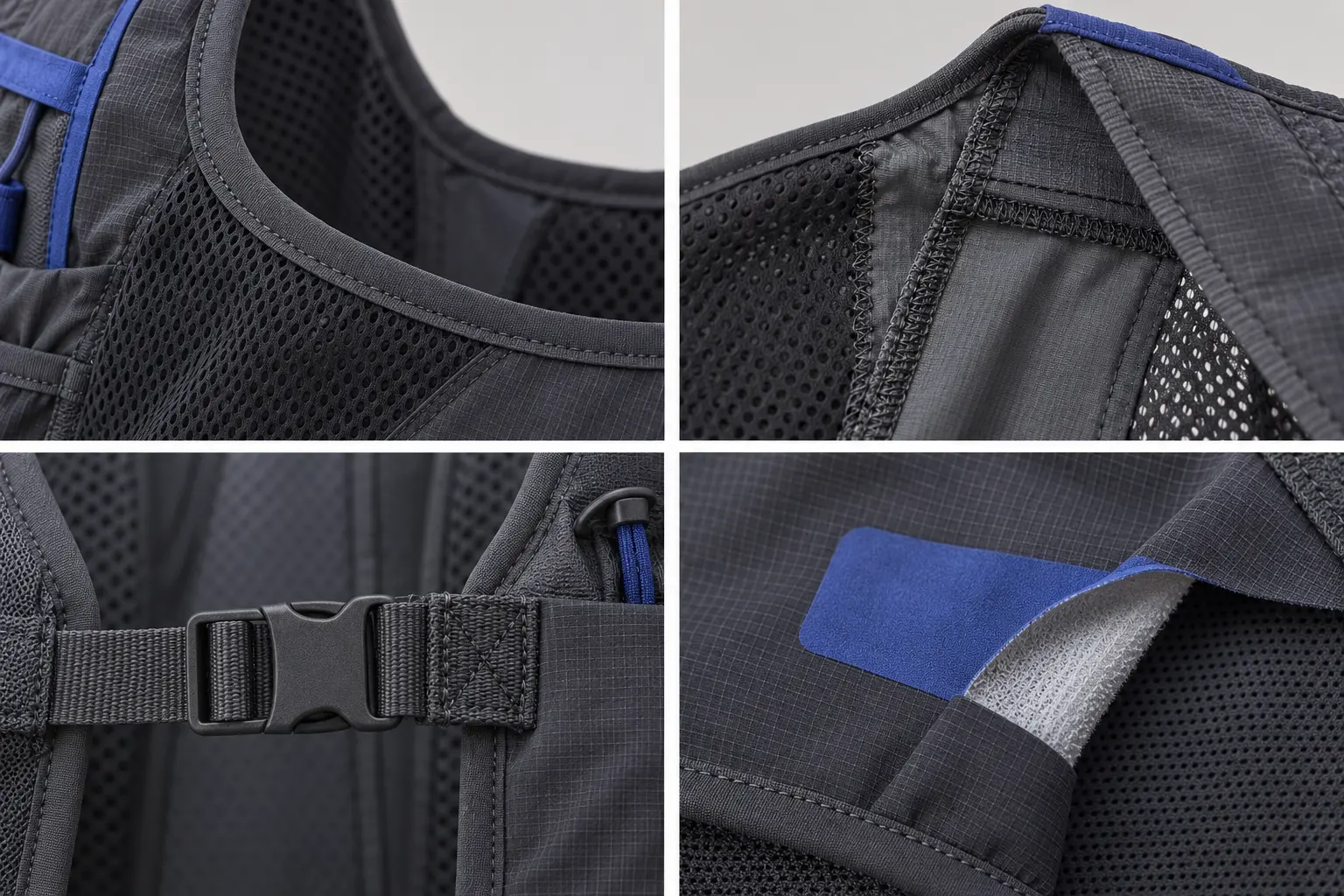
Plan a 500-Plus-Unit Order Before Expanding Variants
Keep the first production specification manageable. Splitting 500 units across several colors and sizes can leave small quantities in each combination, while fabrics and trims may have separate sourcing minimums.
For example, 500 units divided evenly across two colors and five sizes would create ten combinations of 50 units. This is an allocation example, not a recommended size ratio or an accepted production minimum.
Use your own sales evidence to propose the size mix. Then ask the manufacturer to review material availability and the proposed allocation before confirming it.
If the budget is tight, compare fewer colors, available materials, shared trims or simpler secondary pockets. Protect fit, hydration retention and critical construction first. A lower unit price is less useful if the approved product no longer meets its brief.
For broader development requirements, see Voufan Bags’ custom bag manufacturing overview.
Use a Sample Approval Checklist
Agree on the review method and acceptance criteria before testing. The checklist below is a starting point for development, not a certification protocol.
| Review area | Sample check | Record for production |
|---|---|---|
| Fit | Wear with full, partial and reduced loads | Measurement chart and agreed tolerances |
| Hydration | Check the specified flask and reservoir | Component references and inclusion list |
| Storage | Load the agreed phone, clothing and nutrition | Pocket dimensions and closure details |
| Adjustment | Repeat adjustment and check for slippage | Approved hardware and attachment construction |
| Materials | Review contact feel, recovery and care effects | Fabric references and care instructions |
| Workmanship | Inspect edges, seams and loaded attachment points | Construction details and inspection criteria |
| Branding and packing | Check logo, labels, size identification and accessories | Approved artwork and packing specification |
Record changes in one revision list. Approval should identify the sample version, materials and components being accepted. A prototype made with substitute materials should not silently become the production reference.
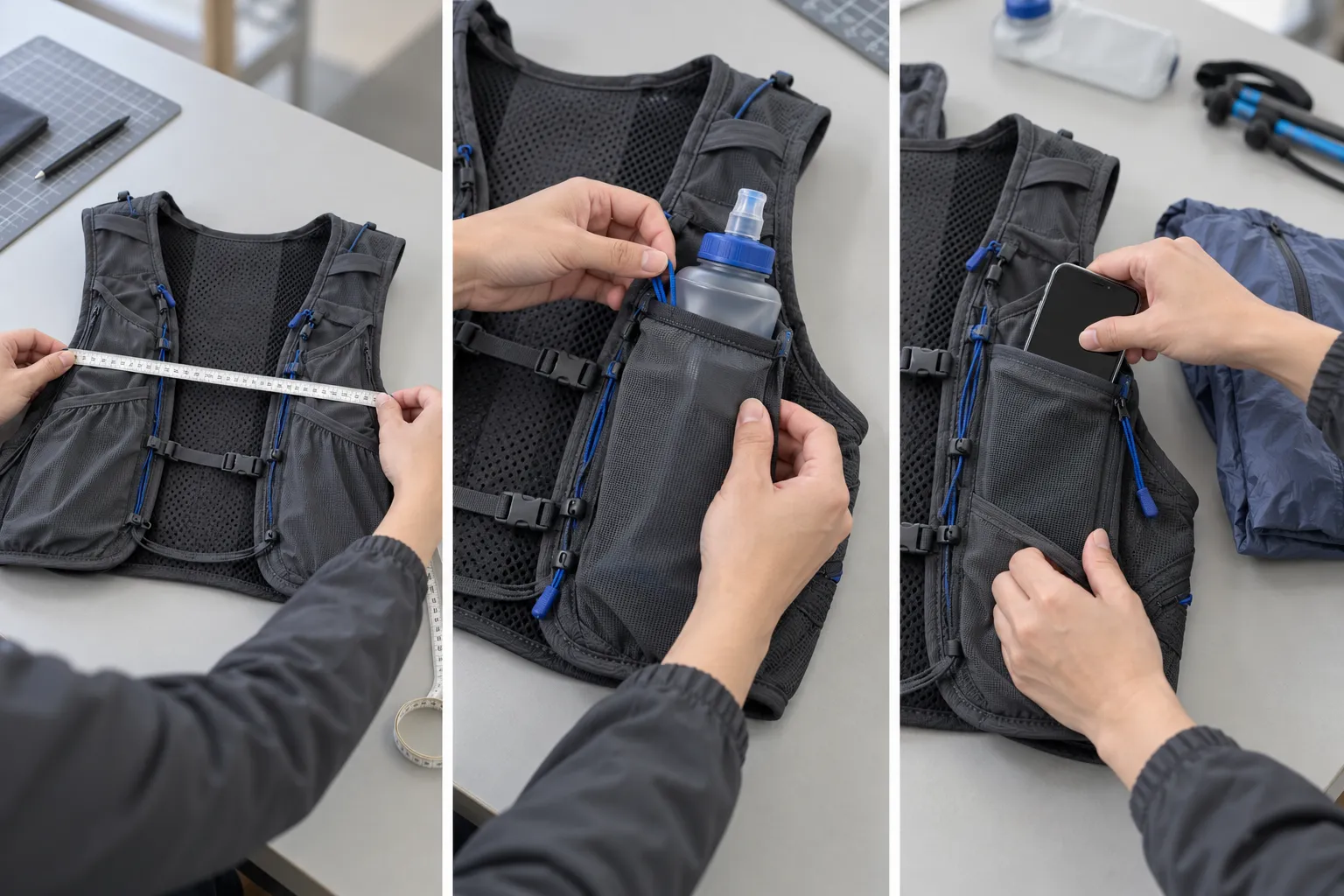
Frequently Asked Questions
Can a reference photo be used to develop a custom hydration vest?
Yes, a reference photo can start the discussion, but it does not define a production specification. Add target measurements, intended load, hydration components and the features you want to change. Use references you are entitled to share.
Should soft flasks be included in the order?
Decide this before comparing quotations. Including flasks creates a defined vest-and-flask package but adds component sourcing and verification requirements. Excluding them requires clear compatibility information.
Can one adjustable size replace several sizes?
Do not assume it can. Check the proposed measurement range on representative wearers with loaded samples. Adjustment must preserve usable pocket positions and comfortable movement throughout that range.
What affects MOQ for a private-label hydration vest?
Materials, custom colors, structure, trims, branding and the order allocation can all affect MOQ. Voufan’s general MOQ usually starts from 300 pieces, subject to the project. A 500-plus-unit plan still requires review of the specific design and variants.
When can the final price and production schedule be confirmed?
They should be confirmed against the agreed specification, material availability, accessory scope and approved sample. Early estimates should identify their assumptions and any unresolved development work.
Discuss Your Custom Hydration Vest Project
Voufan Bags is an OEM/ODM custom bag manufacturer based in Shenzhen, China. Since 2008, we have supported brands, importers, wholesalers, distributors and private-label sellers with custom bag development, sampling, material sourcing, manufacturing and quality control.
For a planned order of 500 units or more, send:
Reference images or drawings you are entitled to share.
Target users, intended load and hydration system.
Proposed size range.
Estimated quantity by color and size.
Destination market and accessory requirements.
These details provide a basis for reviewing construction, sourcing and sample development. Final price and production details are subject to the approved sample.